
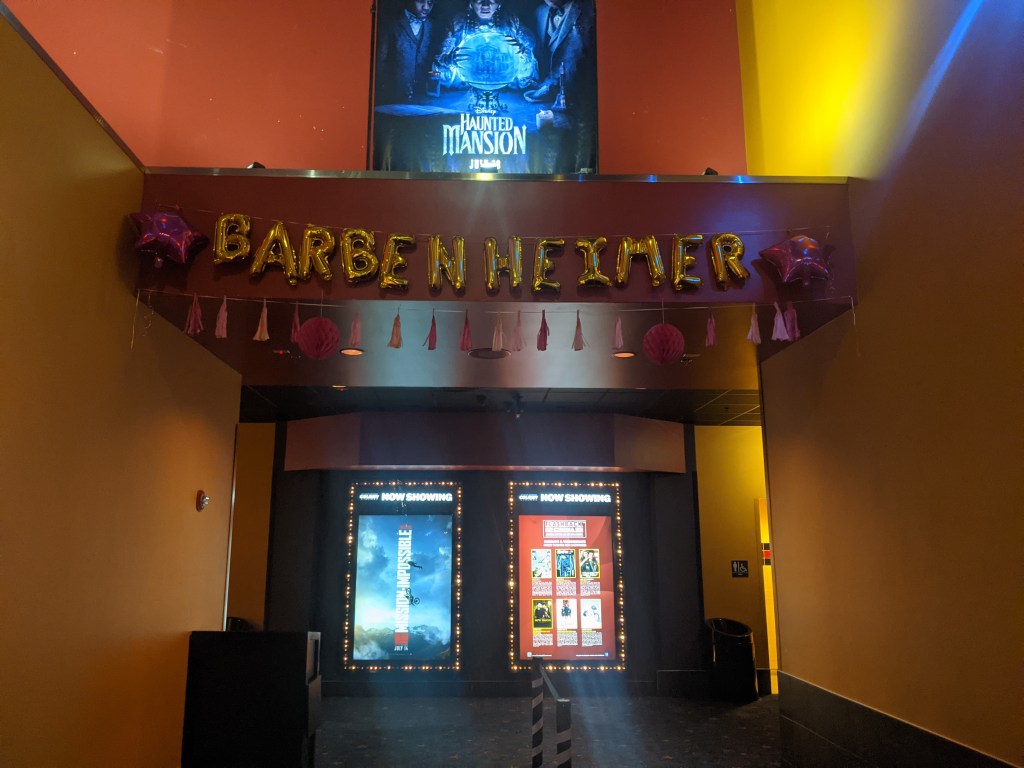
It is September. September is a month of muddled change, a month of sunsets and back-to-school and the idea of autumn, which doesn’t exist in any profound way on the California coast. September definitively marks the end of summer and the slow drip toward the end of the year. It is a month where it is impossible not to think about time.
September is also the end of Pink Summer. Not all summers are Pink Summer, but this one was, a summer dominated by both Barbie and Taylor Swift. It is impossible that you don’t already know this.
I feel the same way about Taylor Swift as I do about suspiciously warm days. Occasionally I enjoy them, but more often than not, I stay inside, complain a little (especially about their ties to climate change), and remain largely ambivalent about their existence. I am not a Swiftie, and most of the songs I know from her are largely thanks to Tik Tok. Like many celebrities, she does fantastic things for people & places, and she is also not above critique.
To summarize, I know very little about Taylor Swift.
Though I did not shell out my monthly earnings to see Taylor, I did pay a hot $14.50 to see Greta Gerwig’s Barbie at a Colony Cinema. I loved it. It was fun and silly and feminine and the music was great.
Much has been written & podcasted about both The Eras Tour and Barbie, and I’ve dug my way through a lot of it. The history of Barbie, the duplicity of being both a self-proposed feminist icon while also a shackle that has limited progress, Taylor’s white feminism & her silence on topical issues, the list goes on. I agree with much of it (but not you, Ben Shapiro), but I am less interested in dissecting content than in the surrounding context. What exactly made it all so magical? Why can’t every summer be Pink Summer?
*************
If you spend anytime in the literary realm, you’ve probably heard of Elena Ferrante, the pseudonymous Italian writer whose series the Neapolitan Novels was turned into the ongoing HBO show My Brilliant Friend.
There’s a lot to talk about with Ferrante—her anonymous identity, her reception among critics, her representation of womanhood & girlhood—but perhaps the aspect of her fame that enamors me the most are the original book covers for the series, all of which were handpicked by Ferrante herself.
The book covers are cute in a romantic and schmaltzy way, an unrefined Mary Cassatt. They are delicate and gentle and soft. They are the types of images you expect to see framed at a bed & breakfast that is lace-draped and perfumed, a China cabinet in the dining room with dainty cups and matching teapots inside. The girls always wear pink and the sky is always blue.
Naturally, critics loathed them. Some booksellers even wrapped the books in brown paper, afraid that the trite covers would dissuade prospective readers from purchasing them. The issue was that the books were good. Really, really good. If they were typical romance reads, or “women’s fiction” (which is an actual genre), then whatever. The romance readers would find them regardless. No advertising necessary.
But the problem was that these weren’t typical romance books. In fact, they weren’t romances at all. They were dark, whorling books about female friendship and violence and nostalgia. And the writing was complicated and refined. These were award-worthy, lush novels hidden behind chintzy covers. And the literary community loathed that.
The problem was that to be taken seriously you have to be dark. True art, they mused, is black. Art is Serious and Important and Dark, not pink and gentle, and certainly not dressed in taffeta. If you’re a woman, fine, that’s not the issue, the problem is that a woman’s life is not Serious Art unless there is suffering, and that suffering must be visible. A man’s life, well, that’s a little different; they’re allowed to navel-gaze (hello, Kerouac), but women, well, their lives don’t produce elite art unless there is violence—blood on the page, screams in the spine. Wounds win awards.
And while the Neapolitan Novels are dark and violent, the covers don’t advertise that. So how would Serious Readers find them? What if they were instead, *gasp*, relegated solely to romance readers, the Danielle Steele, Colleen Hoover fans of the world? The horror!
Nestled in that predicament was the exact point Ferrante was making, I think: If you can’t respect womanhood as a serious subject when it is frilly and pink, then you don’t deserve it at its darkest. Women’s whole lives are worthy of artistic examination and accolades. You don’t get to tune in only for the violent assemblages, the lurid entertainment, then leave once the carnage is done. If the feminine covers are such a turnoff that you don’t read the book, then you don’t deserve the masterpiece anyway.
*************
As I write this, it is now September 17, meaning football season has begun. It is hard to express the enormity of how much I don’t care about men’s professional sports. The whole endeavor is bloated with money & masculinity. I used to live in Pittsburgh, and while there, you had to monitor the Steelers’ games closely—whether you were a fan or not—because it was important to know when the city was spontaneously going to riot and burst into flames.
I find it upsetting and frustrating that men can know so much about sports and so little about other things and that it’s acceptable. Men can talk knowledgeably about batting averages and passing yards (had to google this terminology, tbh) and be unable to accurately identify fallopian tubes on an anatomical diagram and everyone just kind of laughs it off (men are so silly! boys will be boys!) and moves on. Every time I watch an HGTV show and the dude is like, “I need a basement man cave to show off my Yankees hat collection and watch ball games with the bros” and the woman is like “I would like bedrooms for our children, but that might be asking too much,” I feel yet another societally palatable part of myself wither and die.
Men’s interests and hobbies are an engrained part of our culture because that’s how patriarchy works. Women’s interests historically are not. Women can have hobbies, sure, but those hobbies can’t be loud or dominating or command too much attention.
When women’s hobbies are loud or dominating or highly visible, they are frequently lumped into the category of low culture. It’s the romance novel effect—media targeted at women, or that focuses on women, is not laudable art. Make up, entertainment gossip, rom coms, etc. are often considered low culture, something to feel shameful about, something you identify as your “guilty pleasure” because you understand that to enjoy it without guilt would be embarrassing. But the only reason people feel shame or embarrassment is because its consumption is targeted at women.
Everyone I know who loves The Bachelor franchise qualifies it in some regard. I know it’s silly. . . It’s a good distraction. . . I like the community it provides. . . as if you need to explain and justify your interest. Men never do this. Especially not with sports. In my opinion, NASCAR is one of the dumbest, most mind numbing, waste of time sports, and yet I’ve never met a man who says that NASCAR is his guilty pleasure. They have no shame in liking what they like. They don’t feel shame because society doesn’t make them feel bad about it.
*************
There is something nice about being able to forget it all. To have a film that gets it, that acknowledges the patriarchy and limited female power without focusing on or exploiting trauma. Both Barbie and Taylor Swift are sanitized in this way. There is no rape, no gendered violence (genitals don’t even exist in Barbieland). The worst things to happen are that you get your heart broken or someone takes over your house and decorates it with horses and beer. Devastating problems to some degree, yes, but bloodless, no teeth.
Because it wasn’t salacious, wasn’t violent, Taylor and Barbie were easy to mock in the beginning. Silly, frivolous entertainment. Not Elena Ferrante level art.
But then the numbers starting rolling in.
If you know anything about economics, you know it’s largely a Dude Thing. Of course there are excellent women in the economics space, but historically the financial and economic sectors are largely male dominated. Finance is a Serious Thing, a Dude Thing, and Pink Summer became a Serious Thing when people finally grasped just how much money was at play. As of now, it’s predicted that Taylor Swift will gross over $1.5 billion in ticket sales alone and Barbie has made over $1.4 billion and is still playing in theaters globally.
And that’s just in tickets. Just like the Super Bowl, there’s an economic ripple effect. Concert goers sold out hotels. They ate at restaurants and used public transportation. One tourism official said that over $8 million in hotel revenue was largely due to Taylor Swift and her two days in Cincinnati.
People wanted to dismiss Taylor and Barbie as art because they weren’t gritty enough. They wanted to mock Taylor and Barbie because they were girlish and pink. They wanted to look away from all the sparkles because they didn’t care and it didn’t matter and it would be over soon anyway and the only people who really cared were women and girls and they wanted it so badly to be a phase, to be a forgettable crescendo in the noisy & disturbed world, but Taylor kept performing and Barbie expanded to international audiences, and soon the sparkles were blinding and pink was the shade of heaven and earth and it was impossible to not hear the music that surrounded it all.
To a tune of over $3 billion, Pink Summer demonstrated that female entertainment is a very Serious Thing indeed.
*************
bell hooks was a writer and critic who wrote extensively about love and its embedded power. In Communion: The Female Search for Love, she writes, “While romantic love is a crucial part of the journey, it is no longer deemed all that matters; rather, it is an aspect of our overall work to create loving bonds, circles of love that nurture and sustain collective female well-being” (xix). She quotes Susan Griffin: “The wish for communion exists in the body. . . . These meetings were in themselves the realizations of a desire that is at the core of human imaginings, the desire to locate ourselves in community, to make our survival a shared effort, to experience a palpable reverence in our connections with each other and the earth that sustains us” (xviii).
The biggest power of Pink Summer was not the media itself or the money it generated, but in the community it created. As mentioned before, I am not a Swiftie, but I was in awe of the magic, the sense of togetherness that her concerts created. Fans made elaborate outfits and took pictures with one another at her shows, they strung beaded bracelets to exchange, they kept meticulous lists of what bonus songs she performed and had theories of which ones she’d do next. Fans who didn’t get tickets would gather in parking garages, parking lots, or somewhere else nearby to see the twinkling lights of her show and hear the music from afar. Taylor’s shows gave fans a sense of community, which had always existed online, but now it was all in person, and after three pandemic years of isolation and loss, it was all the more powerful.
Taylor’s shows were massive and mostly took place at sports stadiums. The dichotomy in atmospheres—sports fans versus Taylor fans—was seemingly stark. At The Eras Tour, there was no competition, no us versus them. There was no destruction, no violence, no ribbons of anger dripping from attendees’ mouths. There were problems, sure, but to me, some of the most poignant images from those shows were the crowds leaving the concert, 60,000 people in pink all trying to get home. There was no pushing, no shoving, and in half the videos I saw, people were singing, keeping the concert alive for one more blissful hour.
In one video from Seattle, Taylor fans are heading down a set of stairs while baseball fans are headed up. Several of the men make mocking comments about the girls as the men head to their baseball game. In the Tik Tok, the girl muses that they are all doing the same thing: watching people perform. None of the Taylor fans say anything to the men.
And Barbie captured this wonder of community, too. My boyfriend and I sat next to a trio of high school girls in the theater. Can you watch our stuff? They asked, off to do whatever high schoolers do in a movie theater before the movie starts. A row of 30-year-something women sat in front of us, laughing and cheering the whole movie. A girl of about eight sat several rows behind, and I could occasionally hear her asking her dad questions. People dressed up, mostly in pink, and took pictures of the movie promo props.
I got the same vibe from the Barbie crowd as I did back in my Twilight days when I would attend both book and movie premieres. A sense of community, a sprinkle of fandom. Only this time it wasn’t the content we were rallying for, not really. It was the fact that it was made for us, for women, that it saw our silliness, our triumphs, the complexity of our day-to-day existence, and saw them worthy of representation.
*************
Pink Summer was about female entertainment. There were no compromises, no caveats. Pink Summer was for and about the girlies and whomever else wanted to be included. Pink Summer was sequins and sparkles and blondeness and music and best friends holding hands as the sun began to set earlier and earlier and the feeling of girlhood in your throat, in your chest, the feeling that girlhood, that womanhood, was this essential community that we’d all unknowingly let slip by us until now, until now. Pink Summer was an unabashed love song to women.
*************
I work with kids, and on some days I still have hope for the world. Pink Summer gave me hope, hope for girls and their future and what possibilities lay ahead. I hope that the haters are wrong and this isn’t an industry one-off; I hope that women’s stories and interests gain more attention and respect and space. And maybe more than anything, I hope that this sense of community somehow flourishes, that even without concerts or movies, we find space and love for one another.
At the Seattle show, Swifties stomped and danced so much to cause seismic activity on par with a 2.3 magnitude earthquake. Think of all that energy. All that excitement and joy and togetherness. I hope that women & girls continue shaking the world in whatever ways they can.
 People in Parks