
Before
Here’s what you need to know about my before:
I studied abroad in India and the mountains wedged themselves somewhere between my fifth and eleventh vertebrae. I vowed to go back, to feel the Himalaya more deeply, to venture beyond the Garhwali range. I wanted to go for my 30th, but I didn’t quite make it. Two years late. Not too bad.
The more recent before is that it was a hard September. I always want to love autumn more than I do—the foliage, the air, the waning sunlight—but most falls in recent memory have been hard, and this one was no exception. September was collapse, the final strong wave that wipes away the castle, and I was sad and anxious and alone. It wasn’t just the individuality of feeling, though. I felt sad for myself, yes, but also for my coworkers, for the beloved snake I buried in the backwoods, for the people across oceans who were dying and whose names never became headlines.
And then it was late September and it was time to go. The trip I’d been planning for a year had arrived. I pulled an all-nighter and drove to San Francisco at 1 AM where I parked my car and immediately lost my parking ticket and then I boarded a plane and 16 hours later I was in Delhi.
I don’t travel with a purpose, not really. Not in the Eat Pray Love sense. But this time felt different. Life was hard and I was feeling bad, and maybe through the magic of time and the sweat of adventure I would arrive back in the U.S. feeling . . . less bad. That was the hope, anyway.

Day 2 (9/27)
I am in Kathmandu in a penthouse dining hall eating breakfast while watching it rain. Meredith and Charlie are expected this afternoon and in a couple days we’ll leave for our Annapurna Basecamp trek. It is hard to make out much of Kathmandu from the clouds, but it’s a lot of colorful multilevel buildings constructed entirely of squares. There are a couple of tall buildings dotted throughout, but it’s impressive how similar the skyline looks, how the right angles go on and on and there’s no obvious markers of different districts, different neighborhoods. Greenery is laced through the landscape and there are some big lumps in the distance, definitely not mountains but hills perhaps? My biggest fear is that I won’t see the big peaks, that the rain will obscure all of it.
Day 3 (9/28)
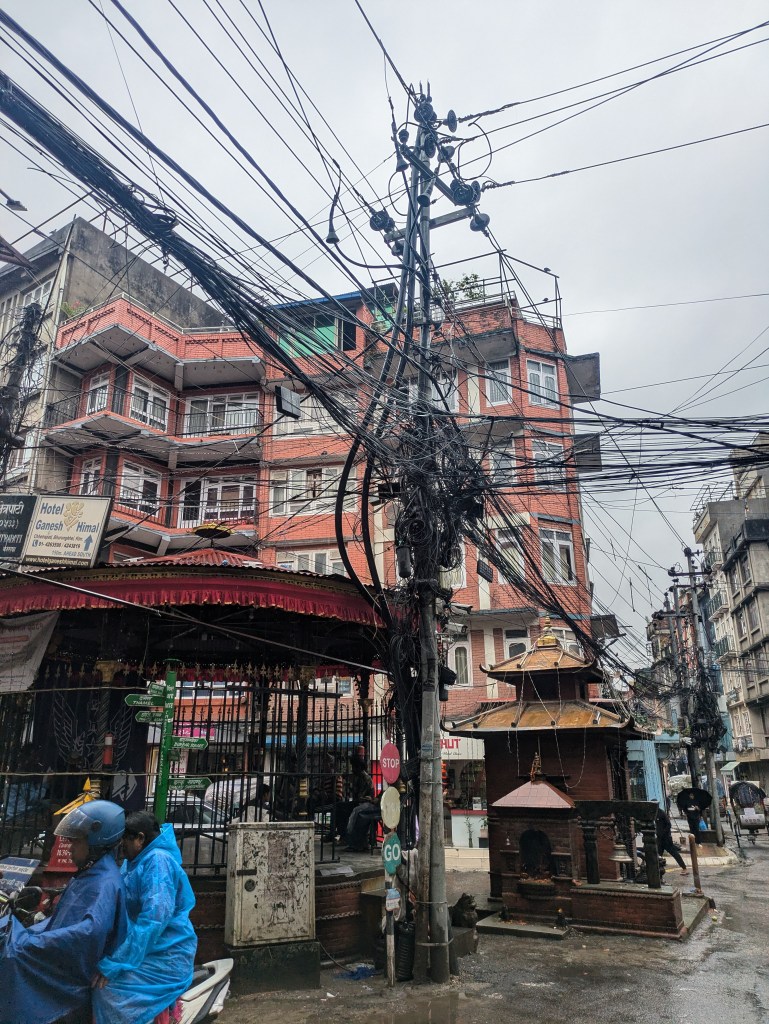
Yesterday was our first full day here. It rained all day, but we walked around and popped from shop to shop. There are a lot of tea shops and knock-off North Face gear. We’re in Thamel, the touristy area, and it all still feels, I don’t know, rugged. Nepal is a poor country, and it feels that way. The horses and mud and street dogs and telephone poles with thousands of wires.
Everyone is incredibly nice. “Are you writing poetry?” one of the breakfast attendants asks me while I scribble in here. “Journaling. Writing about the city.” “I can tell. You look out the window and then write.”
Another breakfast attendant gives me a compliment, something along the lines of being nice and resourceful. I’m not sure where this stems from. Because I don’t need her to get me anything? For some reason this really sits with me. Maybe I am just desperate for a compliment, or maybe I am pleased not to fall into the less-than-flattering American stereotype.
I skim through some old text messages this morning, and all it does is make me feel sad.
Day 4 (9/29)
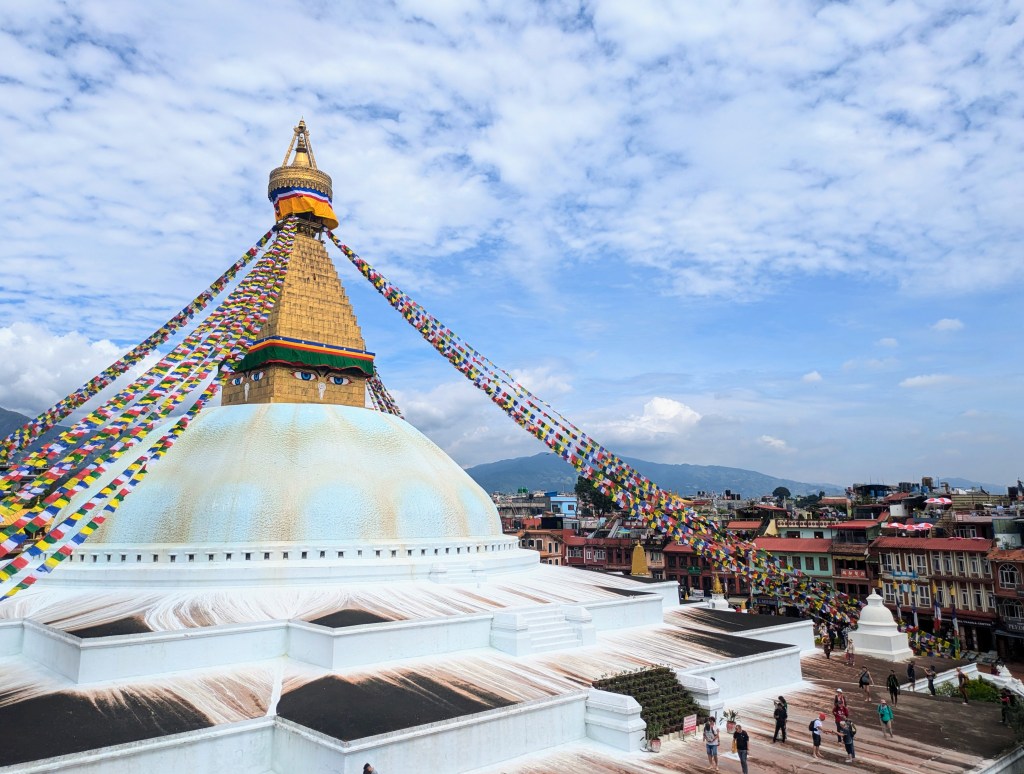
We visit Boudanath Stupa, which is simple yet breathtaking. A huge white dome with colorful prayer flags cascading down the sides. It is staggering in proportion. The place is busy with tourists and also locals, including monks, who are praying as it’s an active and important Buddhist site. As we walk, we muse on who spaces like this are for. Yes, we are allowed to visit, but there are no signs to explain what we’re seeing, only a small one along the walking path that says not to film TikToks. I watch a German tourist interrupt a shaved-head woman and ask her a question about the construction taking place. No speak English, she replies. I find the German woman’s interruption rude.
The area circling the stupa is built up with shops and restaurants and frequented by both humans and pigeons. We dine on the rooftop in the blazing sun, forking down papaya salad and pho and spring rolls.
Kathmandu feels busy and overwhelming. Part of me was secretly hoping I’d fall in love with the city, but I don’t. I wonder what 22 year old me would’ve thought, fresh from my time in India. It is startling who you become and what you leave behind.

Day 5 (9/30)
We fly to Pokhara, which takes forever due to delays. The airport is packed, and we’re not sure if it’s normally this crowded or if it’s because of the floods. It rained grievously Thursday to Saturday resulting in landslides, swollen rivers, road collapse. Hundreds of people died. We knew the rain was severe, but when we looked it up, we couldn’t find any news about it, not until Sunday when our bus was cancelled and the catastrophe made international headlines. We are one step removed, a day late in knowing the tragedy.
Simultaneously Helene hit Florida and Tennessee, and North Carolina flooded, and Lebanon is being bombed, and everything feels hot and volatile, existence a live wire. I expected better from September, a month whose name seems mellow and unbothered, a name like a long exhale.
I can’t wait for the month to end.
We flew and then we drove and then we hiked 1,500 feet of stairs. I thought I was going to puke and pass out at one point, so that was great. Bodies are dumb.
We reached our destination surprisingly fast.

Day 6 (10/1)
October. Finally.
Today is my first glimpse of the high Himalaya. I wake up and over the terraced fields I can see Annapurna whose basecamp is our destination. I walk to the balcony and take pictures of the mountain and the groggy morning light. It is green and gentle and warm. The rest of the valley is wispy with clouds.
I eat a piece of Tibetan bread slathered with peanut butter for breakfast along with a cup of masala chai, and then we strap on our packs and follow our guide, Asish, to the path.
The trek to Annapurna Basecamp winds through mountain villages. Part of the allure of this trip is the mountains, obviously, but also the culture you experience as you hike. Each night we stay in tea houses, and all of our meals are eaten there as well. Asish provides directions and does the logistics, but we haul all our own gear, unlike many of the other trekkers who paid porters to slog their stuff.
Most of the tea houses are immaculate, at least on the outside. Many are painted a deep ocean blue (Nepali blue, I’ll later hear it called) and their trim a hue of rose. Blue roofs the same color as the facade cap many of them, creating a cohesive cluster of colorful houses nestled together in the sloping green valley.
We pass dogs and water buffalo, rhododendron thickets and terraced fields of millet. All of the dogs are clean and fluffy and are largely uninterested in us. We wave to the chickens and farm animals when we pass and say namaste to the locals.
It is less steep than yesterday, and my body feels better. I think about my stomach and how my clothes are tighter than I want them to be and just generally how big I feel. I think of work and the people I’ve left behind.
Asish says it’s safe to order pizza at the tea house we’re staying at, so Mere does and it looks awful. Dewy and warm, the so-called margarita pizza dotted with olives and cheddar cheese.
My room is a corner room, like a cube, and I hear noise from four of the six directions. The trek was scenic, but this evening’s been loud. We have to wake up early for sunrise, and I’m worried about getting enough sleep.
I think about things that make me sad, and I end up crying. Not much, but a little.
I dream of snakes.

Day 7 (10/2)
I wake up at 4 AM because people are noisy. It’s not their fault; the walls are thin and they are doing normal people things, nothing obscene.
We leave at 5 AM and wind our way up Poon Hill. We pass groups of people and others pass us. Up and up along the stone path. I use my headlamp for the first 20 minutes and it is just dark enough to make out the seven sisters, Pleaides. And then I find Orion and Cassiopeia. Halfway around the world and the night sky is the same as California.
We summit Poon Hill around 5:45. This is our first time seeing the Dhaluagiri Range. Dhaulaugiri itself is steep with shaved off sides like someone took a razor to the front. And then there is Annapurna South and Machupuchre and Hochuli and Niligiri, names I am trying hard to learn how to pronounce.
It feels unsatisfying to write about what one feels in the presence of a mountain because there’s no way to capture it. I write a lot about nature, but the feelings I attach to these experiences are harder to describe than these that come with human relationships. It ends up sounding overly sentimental or derivative, a pastoral romance. I can find words for heartbreak, for sadness, for so many other things, but I just can’t grasp the language for what I feel in nature.
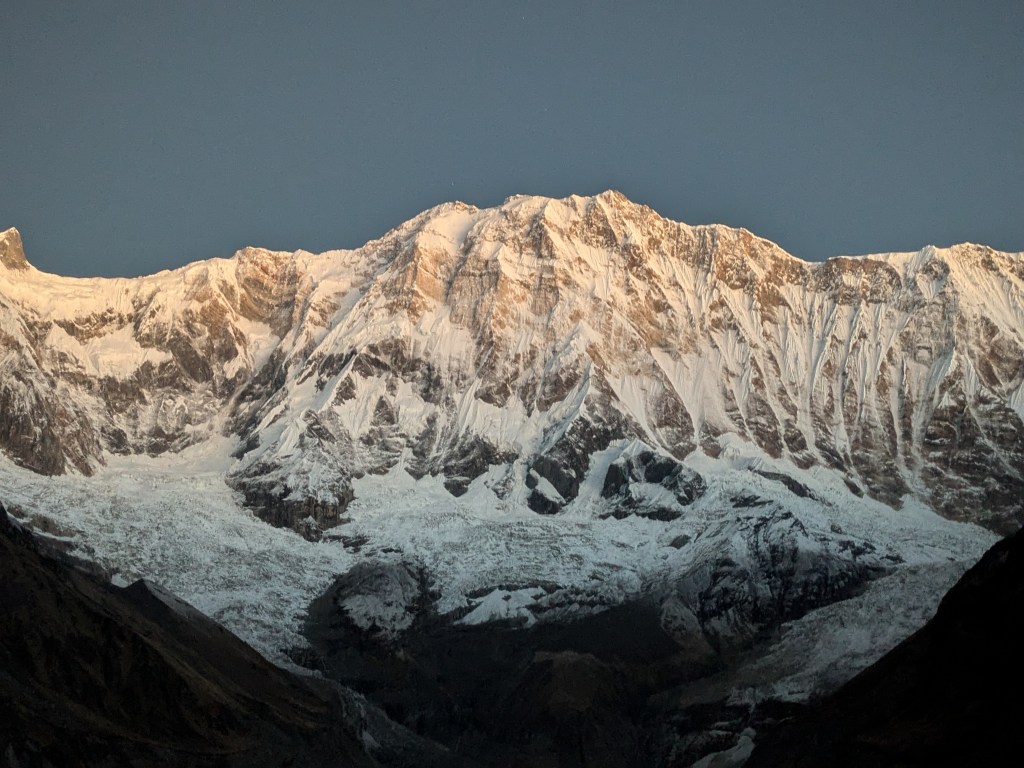
But it was magical, that’s what I’ll settle on. The sun rose and we watched the Dhaulaugiri Range slowly illuminate, the summits glowing gold and light slowly spreading down the peaks. Alpenglow, they call it. The gentle wash of light on mountains. Watching the mountains change color was more exciting than sunrise itself. The pale purple of the sky slowly dripped away yielding the blue earnestness of mountain morning.
We hiked down, ate breakfast, and packed our bags. We were out the tea house door by 8:30.
It was immediately uphill and the elevation was getting to me. Asish tried to be motivating, but I just wanted to be left alone, sucking wind without trying to make conversation.
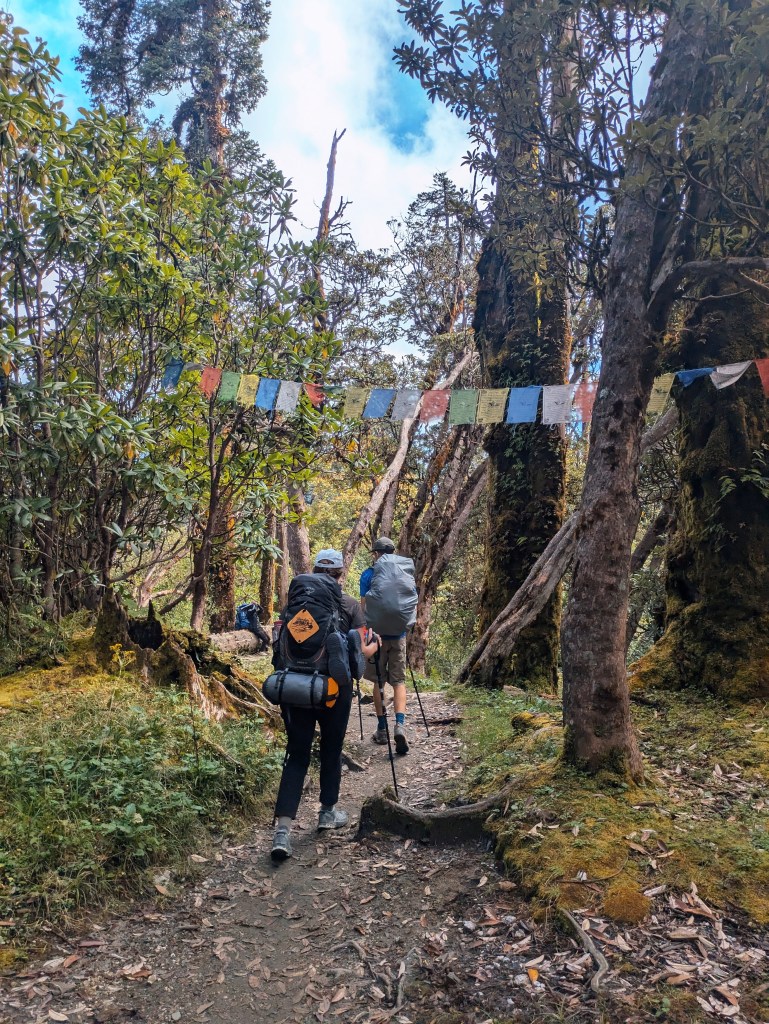
It was a day of verdant moss draped forests and squelching mud. Up down, up down.
We were all a little quiet until lunch. Today is one of our longest and hardest days. We are hiking up to elevation and then coming back down, a morning hard on the lungs and an afternoon that’s hard on the knees. We eat lunch in a canyon with prayer flags cascading down. At a table nearby, a group of Slovaks sing and play the guitar. Asish chats with their guide and tells us that they are finishing up the Annapurna Circuit, a harder and longer route than ours.
Watching the other hikers is one of my favorite parts. My sister and I call it watching television. We did the exact same thing at Havasupai this summer—we’d sit at our campsite and just watch people come and go, marveling at what people packed in and what gear they’re using and where we thought they were headed. At this point in our trek, we’ve seen many other groups, but the routes are serpentine and we’re not all headed to the same place. At lunch, we see the group of two British girls who passed us on our very first day. They have suspiciously small packs and no porter, and we are deadly curious on where they’re going. They refuse to use water purifying tablets, and instead buy bottled water that they dump into their CamelBaks.
We make it to Tadapani at about 1:45, about an hour before it rains. I am warm in my now sausage-fitting coat and grateful to be dry, but I think it’s going to rain tomorrow, so here we go.
I’m enjoying the trek, but today I am tired and my legs are sore and it’s always easier being home.
Day 8 (10/3)
This is the first time I’m not hungry. I poke at my breakfast. The porridge tastes weird, but the masala tea is the best yet. I’m not hungry, but I know I need fuel. I eat two hardboiled eggs and some toast.
It’s very hot and humid today. I begin to feel a little defeated on some of the inclines. I wonder what Asish thinks of us. I worry he thinks I’m a fat and slow American, which, honestly, I couldn’t really argue. I feel my size on this trip. I am so much taller and bigger than the locals. Sometimes I think about my size and feel weird about it, and then I remember I’m literally trekking through the Himalayas and I shut up.
I can feel my once-broken foot as we walk. An upper portion feels off, not in pain, but wrong, the fact that I’m feeling anything at all a worrisome sign. Sometimes I consider surgery again, but the cost and recovery always holds me back.
We stop for lunch at 11:30ish. I just get chapatis, which are amazing, and I drizzle them with honey. M & C brave a salad, and I tell them that I’ll be the control if they get sick. We eat a massive cucumber slice sprinkled with salt, and it ends up being one of the food highlights of the trip. The food is terrific—satisfying and not greasy, grown right in the fields just beyond the porch where we sit. Meredith and I both get Sprites.
We are working our way across the green mountains. Machupuchre in the distance. Millet terraces are dug into the hill and the river winds below.
We get our last shower and maybe our last solo rooms. It rains again, and we watch it safely from the plastic chairs underneath the awning. It is another night for earplugs.
We’re at the point in the trip where we’ve developed a rhythm. Hiking all morning, lunch, a short afternoon, sitting and reading, early dinner, early bed. I’m glad we have down time. I think that helps everything sink in more; I don’t feel pressure for every moment to be the best.

Day 9 (10/4)
I wish I was a more resilient, can-do person. The stairs are hard, and I think negative thoughts as I climb them. I ruminate about giving up. I think about how terrible some of these staircases will be in reverse. I wish I had more confidence and strength and that challenges felt motivating instead of defeating.
We pass through the villages of Chhomrong and Supai, and they are stunning. Flowerboxes in the foreground, mountains in the back. We will pass through all this again in 3 days on our way out of the valley; it’s the only part of the trek we’ll do in reverse. We tell ourselves we’ll stop at the German bakery for baked goods and coffee on the way back, a small treat to break up the relentless stairs (spoiler: we don’t stop).
Today is nothing grand. A trudge of elevation through greenery, slowly gaining height. We’re at 8,000 feet tonight.
I think about work and how I dread my email and the dumb routines of existence. I fight with my ex-boyfriend in my head and almost burst out sobbing on an uphill. I think about playing Civilization.
Now that everyone is being funneled the same direction, we see the same faces. We are obsessed with the Asian couple who is doing a 3-day approach and say they may take a helicopter back (how casual! how nonchalant!). They are dressed in Arc’teryx and carry tiny packs. There’s the Indian man with a guide and porter, and the Czech people with the kind of hot dad, and three massive groups of Brits whom I keep mixing up. Then there is my favorite group, the Koreans. There are 10 of them, men and women, and no one is under the age of 55. They not only have a guide and porters, but also a private chef and entire kitchen team who will make them separate meals at the tea houses. One meal we observe consists of 3 whole chickens, noodle soup, and kimchi, along with some other dishes I can’t identify.
When we arrive at the tea house, we just sit and watch the people stroll pass.
It always rains.

Day 10 (10/5)
Almost there!
Tomorrow is summit day, which is what it feels like but in reality it’s not a summit at all, it’s actually the opposite: basecamp. I was worried about the elevation ascencion today, but it was fine. I felt strong! Finally! It’s probably a combination of cooler weather, fewer stairs (stairs are way harder than slopes), and yes, stronger muscles.
We stopped in the town of Himalaya, and I got a vanilla latte, and it tasted amazing, and it was so lovely to sit and sip coffee with two of my favorite people in this blue-ceilinged valley on the opposite side of the world. What a gift. What a joy.
The peaks around us are towering and jagged, their craggy sides covered in green patches. Think Iceland. Think Ireland. I never knew Nepal had so many breathtaking waterfalls.
It’s getting colder. I’m writing this wearing a puffy and a base layer. I like the cold, though. It feels more homey than heat.
This tea house is less exciting than others. Mostly a group of unfamiliar faces, which is terribly disappointing. There are fewer tea houses up here and they aren’t as nice as earlier ones, mainly because of the climate. Where earlier villages had farming operations and existed independently of the trekking industry, it is too rocky and cold up here to sustain much community or agriculture. The tea houses here are mainly for tourists, and most of the owners don’t live here full year round, unlike the others.
I ate dahl baht twice today, which is good and also I’ll be glad to see no more of it at the end of this trip.
My imaginary conversations continue. In one scenario, I befriend the Koreans and one of the old men gives me his hat, which says “I LOVE KOREA.” It becomes my favorite souvenir of the trip and I wear it all around Morro Bay (spoiler: this never happens). I imagine running into certain people at the local grocery store and they ask me about my hat, and I get to tell them this crazy story (spoiler: this also never happens).
I think about Nietzsche, absurdly, and how I know more about him than I do about farming millet. Academics feel so meaningless sometimes. I think of Asish and how our interior worlds are so different. Our exterior worlds, too. He can climb these trails with no labored breathing, and here I am sweaty and tired and thinking of Nietzsche. I don’t ask him, but I don’t think Asish is thinking of Nietzsche at this very moment, or perhaps ever at all.
One thing that Asish and I have in common is that we both use TikTok. Most of the porters and guides use social media. In the tea houses, we’ll be sitting and drinking tea, looking out at the mountains, and they will be scrolling on their phones. Maybe the mountains are less magical when they’re a routine part of your job. I scroll on my phone at work, too. I stubbornly resist all offers of WiFi, which Asish graciously extends. One of the best parts of traveling is being disconnected from the threads of daily life, and it feels nearly sacrilegious to load a web browser up here.
Asish tells us many things as we hike. There’s a bit of a language barrier, and it’s interesting what words don’t translate. “TikTok” is understood, but “glacier” isn’t. He tells us that the road to becoming a guide is long. Most start as porters and eventually become logistics assistants and eventually guides. Your ability to become a guide depends on how well you know the area (Asish does not lead any of the Everest treks) and also your language skills. Many guides will specialize in a language whose demographic are frequent visitors, like Chinese or Korean.
Many porters are young, and I feel conflicted. I am glad they have a job that supports them, but I am sad they’re not in school. What opportunities exist for them outside of this? Will this open doors for them in the future? But maybe I have a narrow conception of education and what it should look like. Maybe being a porter and a guide is it’s own equally valuable education. Who am I to say.

Day 12 (10/7)
We did it!
Yesterday we hiked into basecamp. It wasn’t a particularly hard hiking day, but I could feel the elevation. 13,000 feet. More stairs, of course. We got in around noon, and the Annapurna Sanctuary was already swallowed by clouds and remained so all day. We sat in the dining hall the entire day reading and eating and watching people. Charlie watched the front door and started tracking how many people left it open. People would leave it open and then a guide or the owner would close it a minute later, and the cycle would begin again. None of us could figure out why basic etiquette seemed inapplicable.
Most people at this lodge were new, which was unfortunate. I wished the Koreans were there.
We read and sat and then read some more, and then drank tea and ate noodles and then donned our base layers and down sleeping bags as we went to bed. And then at 5:30 AM headed out into the sanctuary.
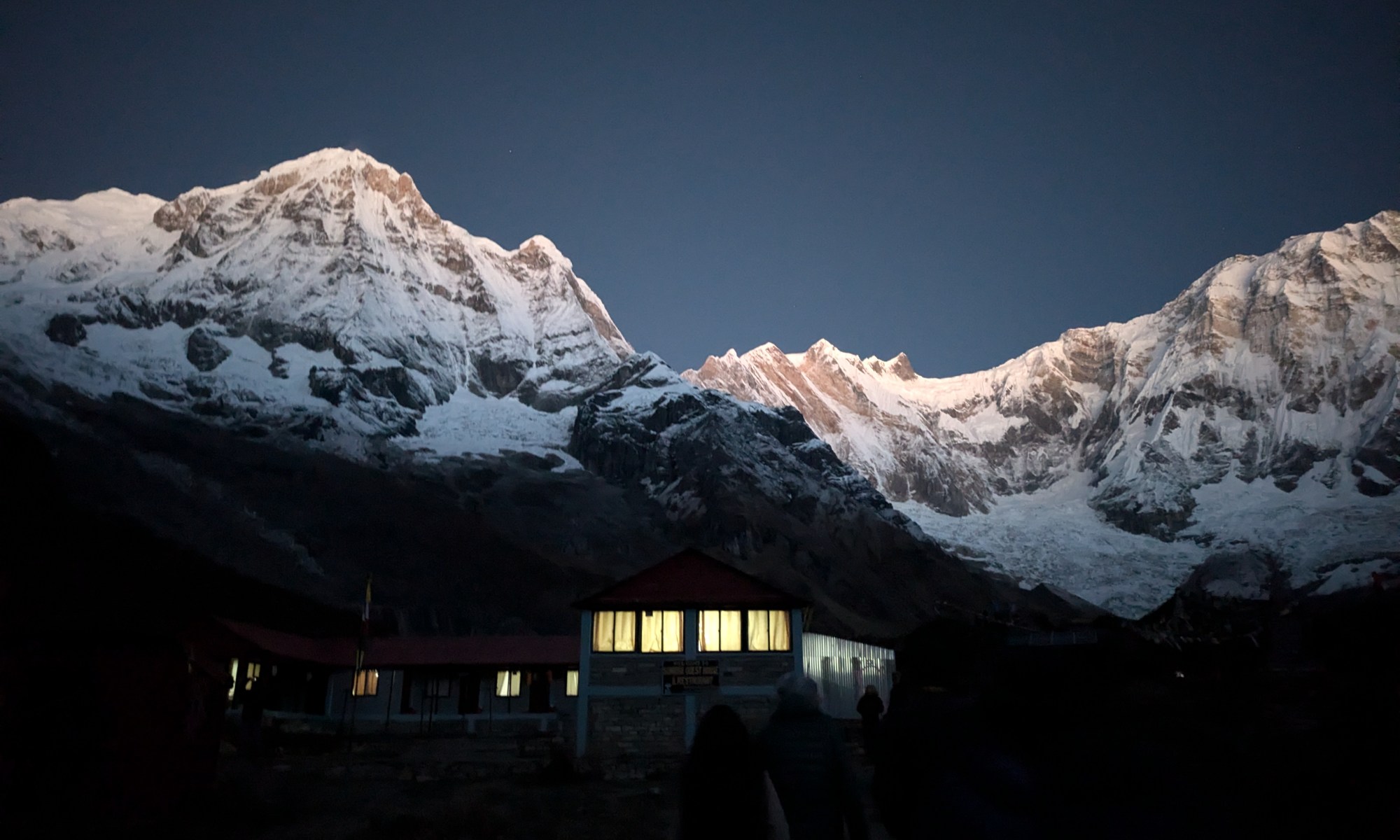
It was breathtaking immediately. The mountains were strong and visible in the night, their white faces stark and grand over the tea houses. They felt more alive than ever before.
We stood on a ridge and watched sunrise over the Annapurna Sanctuary. Some of the peaks were the same from Poon Hill—Annapurna, Machupuchre—but it felt like I was meeting them for the first time. It was like I’d waved to them down the street, catching only a glimpse of their hair, their coat, and this was the first moment our lives had truly touched, that I’d seen them in their beauty and they’d seen me in mine.
This is the moment I’d come for. When I think about this trip, this is the memory I hold closest. Me, the mountains, and the darkness. Watching alpenglow in the sanctuary, the words themselves are hymns.
We snapped pictures and took our time and then started the long march to lower Sinuwa. It took about 9 hours—6,000 feet of downhill and some gnarly uphills too. My knees ache and my feet feel pounded flat. The surgical portion of my foot throbs. It was a long and kind of boring day. The mountains recede behind us.

Day 14 (10/9)
We hiked out yesterday. Down down down. One final lunch stop for momos and Sprite before taking the Jeep out of the conservation area.
In the rest stop, a young guy started talking to us, asking us where we were from and what we thought of Nepal. He was Nepali and he said that he had an interview next month for an American visa where he was trying to get his masters. Where? We asked. New York or California. He seemed like one of those people who, understandably, doesn’t truly fathom how large America is. It’s my dream country, he said. Nepal is about 70 years behind America. There is no opportunity here.
What does the future feel like here? I think of all the porters, many of them young boys and men, and I wonder what they envision for themselves. What the future begs to promise.
In my own life, I feel like I have so many choices. So many lives I could claim if I wanted to. I am not proud to love my country, but I do. I love the ocean and the bristlecone pines and the midwest towns where gas is $2.80/gallon. I love the 24-hour donut shops and the reliable electricity and how 32 years into life I still feel like there’s so much to explore. I am so grateful to be from a wealthy, privileged land, and I understand other people’s envy. But everything’s always greener, right?
We pass the three rude Brits as they walk along the road. I hope they have a long, hot walk out.

Day 16 (10/11)
We spent one full day in Pokhara where we walked around and ate at an ayurvedic café, and I questioned if a specific mixture of herbs can really cure hysteria. Our goal was to watch sunset over the lake, but it started thunderstorming so we got thali and then smoothies and stayed inside.
I wasted a lot of time on my phone looking up videos of Hurricane Milton, yet another climate tragedy. It felt urgent and pressing, like I had to be informed, but I also couldn’t change anything, and watching all the videos just made me anxious. I still can’t figure out the right amount of media to consume. Why didn’t I just journal? Why didn’t I just do that? Two weeks hiking in the Himalaya, and on the cusp of civilization I am already on my phone again. I feel stupid and regressive.
Pokhara felt like Rishikesh in regard to the fact that there were hella white people exuding a yoga/free-spirit vibe. How long are they here for? What do they do all day? I try to eavesdrop on a date nearby in the ayurvedic café. It seems like a very serious conversation regarding spirituality and relationships and once again I want to be a different person, to think and believe in that type of stuff. In another life, I fall prey to a health and wellness grifter scheme; I collect crystals and match my personal calendar to planetary alignments and refuse to eat certain types of oils. I wished I cared more and believed more in things like that, but I don’t.
We spend all the next day on a bus from Pokhara to Kathmandu. Literally all day. 7:30 to 5:30. The trip is only 93 miles, but it takes the whole day because the roads are so bad. We pass hundreds of other buses as this is the main mode of transport and people are going to their home villages for a national holiday. The road is pitted and muddy and about 1/3 is not paved. We wobble along, bodies jostling with the ruts.
We pass billboards for electric vehicles. “Give us a missed call,” they read, and I wonder if an EV would last on these roads. Nepal is a juxtaposition of the very modern and the very traditional, a country with a constitution just approved in 2015, the last Hindu monarchy in the world.
We spend one last day in Kathmandu. Monks work on MacBook Pros in the coffee shops of Kathmandu while a YouTube video promoting Nepali destinations plays in the background.
How does one hold onto and respect the past while plunging into the future?
The country is in the midst of celebrating Deshain, a major Hindu holidy that only the Nepalese celebrate. Shops are shuttered and the women are dressed in red traditional kurtas. We pass a small temple on the main street and notice a goat head at the base, blood streaming into the gutter, impossibly red. His forehead burns with incense.
My biggest regret is not sitting with the mountains longer, not waking up at 3 AM and sitting with the stars and watching the massifs surround me. Even with so much down time, I felt rushed when our moment at basecamp finally arrived. I failed to plan. Failed to seek the magic. Sometimes even when I’m living in a moment, I also live outside of it, watching myself experience it. Am I doing enough? Am I having the most fun? Could I do more to experience this moment fully?
But if I’d left at 3 AM, maybe then I would’ve been too cold, too tired. Maybe that would’ve made my whole day awful. I struggle to find the balance of comfort and preparedness and the sense of fulfillment that comes from pushing beyond those boundaries. How do you hold it all?

Back
I’m back, and it all feels so normal. Emails and driving and my messyneat apartment. I have a weekend to feel like a person again, and then it’s work and everything picks up where it left off.
In a dream world, I’d have a second vacation of me sitting in my apartment processing everything and writing.
In a dream world, I would be a changed woman. I would come back joyful and reinvigorated and life would feel novel.
In a dream world, September would be less haunting.
The arrival back from Nepal was the most jarring in memory because nothing was different. I went to Nepal for two and a half weeks, and then I returned, and my life in California was no different. I was no different. Time had simply passed. September was further away. We always want travel to change us, but it’s merely respite from routine; every spoon is in the drawer like you left it.
It wasn’t always like this. My time in India was transformative, as were many of my cross country road trips. Life after those experiences fit differently. The horizon was closer and more brilliant.
I wonder if all my travel has somehow ruined me. If I have to travel further, be more adventurous than ever before in order for the impact to be the same. Sometimes I worry that the best moments are already behind me. I worry that my brain doesn’t hold and cherish experiences like it used to.
I got back from 27 hours of travel, and then I took the weekend to feel semi person-like, and then I went to work and rehashed the same tidy summary of my journey to anyone who asked, and then kids arrived and the phone rang, and my apartment still needed cleaning. I never once mentioned the leeches that suckled on cow’s blood. I never once used the word “alpenglow.”
In writing this, I relive it a third time—there’s always three times for travel: the planning, the experience, and the memory—and the memory still breathes the same. Nepal was a destination I’d been thinking about for a decade and I’d gone with such a sense of hope, of transformation. But maybe the sameness I feel tells me everything I need. Maybe you can’t force evolution. Maybe supernovas happen of their own accord, without planning, without intention. Maybe the moments of alpenglow and the gift of California persimmons sustain you, move you, in the same way. Maybe sometimes the adventure is being the one who stays.


 People in Parks