
December 4, 2025
Day 1, California –> Berlin
Getting your body from one point to another is exhausting. I wake up at 2 AM, drive to San Luis, park my car, walk the 1.5 miles from my friend’s house to the airport, and then fly on three different planes and walk through four different airports to get to Berlin. It’s early morning when I arrive, and I’m exhausted. I can’t figure out where the S-Bahn station is at the airport terminal, and I walk around like an archaeologist trying to interpret the airport signs and find the correct train line. I can’t figure it out. I pause, realize I am hungry and stupidly tired, so I buy a cup of yogurt at one of the airport takeaway places and regroup. I immediately find the S-Bahn stop right after that.
My hostel is a 1-hour train ride from the airport. We pass through gray, brown fields, and houses with steeply pitched roofs. It looks like New York, I think, the empty spaces, the sepia nature cool-toned world.
There’s a Dunkin at the S-Bahn station at Alexanderplatz, and Germany somehow feels even more New York. My butt aches from sitting for 15 hours, and walking to my hostel from the train station sounds ideal. It’s a 20 minute walk. Past McDonalds. Past Burger King. I refuse to pay for an international roaming plan, so I just use Google maps sans internet connection, reading the interface like a normal map, no mechanical voice telling me when I’ve missed a turn.
It’s too early to check in, but I stow my bags and head out to grab coffee and food. Tash Sultana and LP are playing through the speakers at the coffee shop. The barista speaks perfect English. I am wearing my Icelandic sweater, Blundstones, and California sun-faded pants. My jacket is the same puffy I wore last fall in Nepal. My scarf I got in India 12 years ago.
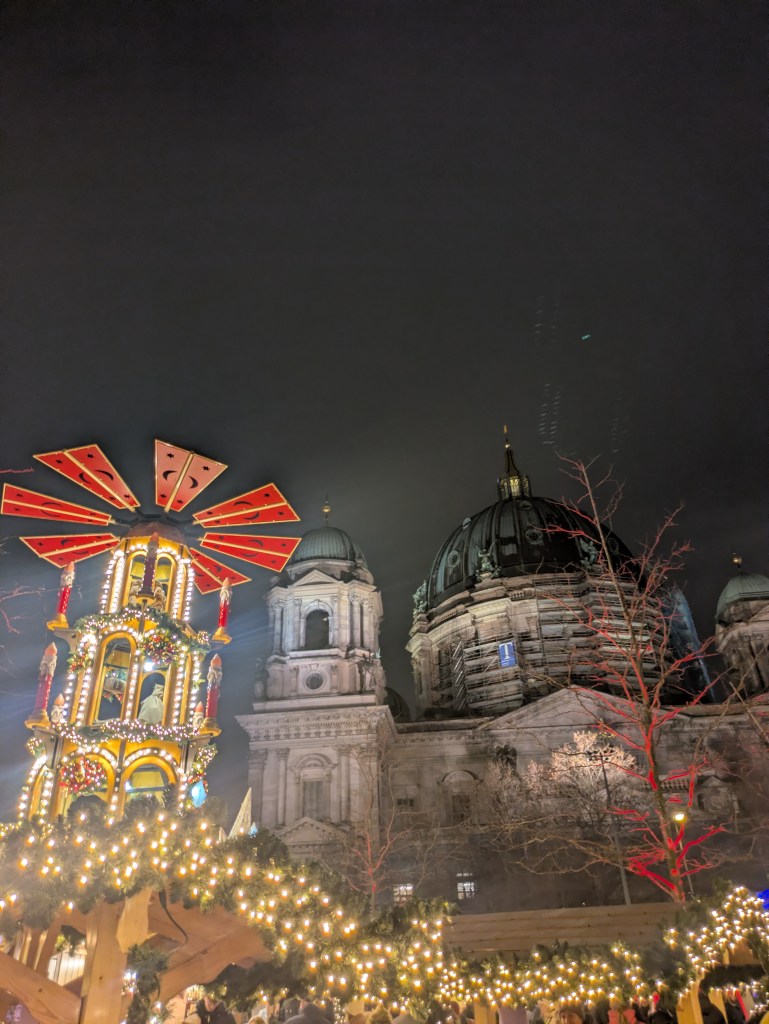
I check in, take a nap, and then walk with my internet-less phone. I make note of places I should take my sister. I stumble upon a section of the Berlin Wall and take several hours to look around and read the plaques. I walk through the Alexanderplatz Christmas markets, enough to get excited and scope them out, but not enough to ruin it for when my sister arrives. I walk further south to Museum Island where another Christmas market is. They’re playing pop Christmas music and projecting falling snow on a Romantic-styled building and there’s an illuminated Ferris wheel nearby and everyone is laughing, drinking mulled wine, and I am here, I made it.
Miles walked: 9
December 5, 2025
Day 2, Berlin
M arrives today, so I have half a day to explore but not go too far.
For breakfast I go to an Italian place I saw yesterday that advertised a lunch special of coffee, a pastry, and homemade pasta for 13 euros. The croissants aren’t ready yet, but I order one anyway and sip a latte while I wait. I finished an entire book on the plane (“The Friend” by Sigrid Nunez, not as good as I’d hoped, but she did spend some time in Berlin and that felt serendipitous) and now I’ve started a YA book about kids who get lost during a wilderness therapy course (very compelling!).
My sister and I travel well together because we like to walk. That is the activity we structure our trips around. For us, it’s not just a mode of transportation, it’s a way to experience places, to spend time together. Walking is one of my favorite hobbies. I love the slow sense of exploration, of peeling back the world one foot fall at a time. I love to put on headphones and walk around lost in imagination, drifting in and out of daydreams, my body in rhythm with the world.
In good walkable cities, you never need a plan. Just go where it feels right. If it starts feeling weird, turn left, turn right, head another direction or go back the way you came from. In our American world of intense structure and abruptly ending sidewalks, walking and wandering, stopping to look in windows and trying unplanned meals, feels revelatory, a middle finger to the productivity man, a culture that tells us to optimize our lives and regard time as currency. Unstructured walking feels like a tiny rebellion, as boring as that sounds.
I end up in an apartment district that feels very utilitarian and Soviet, blocky and gray. There are a myriad of outdoor gardens that are pleasantly overrun. I walk east and find a populated bustling district with shops lining the street. A porridge shop looks intriguing and I make note to take my sister here. I buy a book in translation of interconnected stories about Berlin.
Walking allows me to feel like someone else. As you walk walk walk, you slip into a different persona. You look at porridge shops and art galleries and convince yourself that you could live here, that this could belong to you. You think of the food you’d eat and how you’d spend your time and how this would be your city phase, your European era, how you could be an urbanite if you tried. You walk and you admire the city and its people, and in your daydreams you never think of rent or groceries or friends. Travel abolishes the practical. You are just a tourist thinking this could be yours.
M arrives and we get lunch at a vegan Vietnamese restaurant, which will be some of the best food we eat in Berlin. It gets dark around 4, and we end up back at Alexanderplatz for the Christmas market. We get two flavors of gluhwein and I end up drinking both because my sister doesn’t like them. We eat more market food—an open caprese sandwich, a nutella crepe, and a short crust amaretto-infused ball whose German name is lost to us that we bring back to the hostel and eat in bed.
Miles walked: 13.7
December 6, 2025
Day 3, Berlin
People immediately switch into English when we talk to them. Be careful of the guy out there, the barista says, an older man making our drinks beneath black and white photos of American musicians. He’s a zombie. Too many drugs. M and I nod in assent as we watch the presumably homeless man stumble around outside. You from New York? Philly? The barista asks. We nod again. Well, you know what I’m talking about.
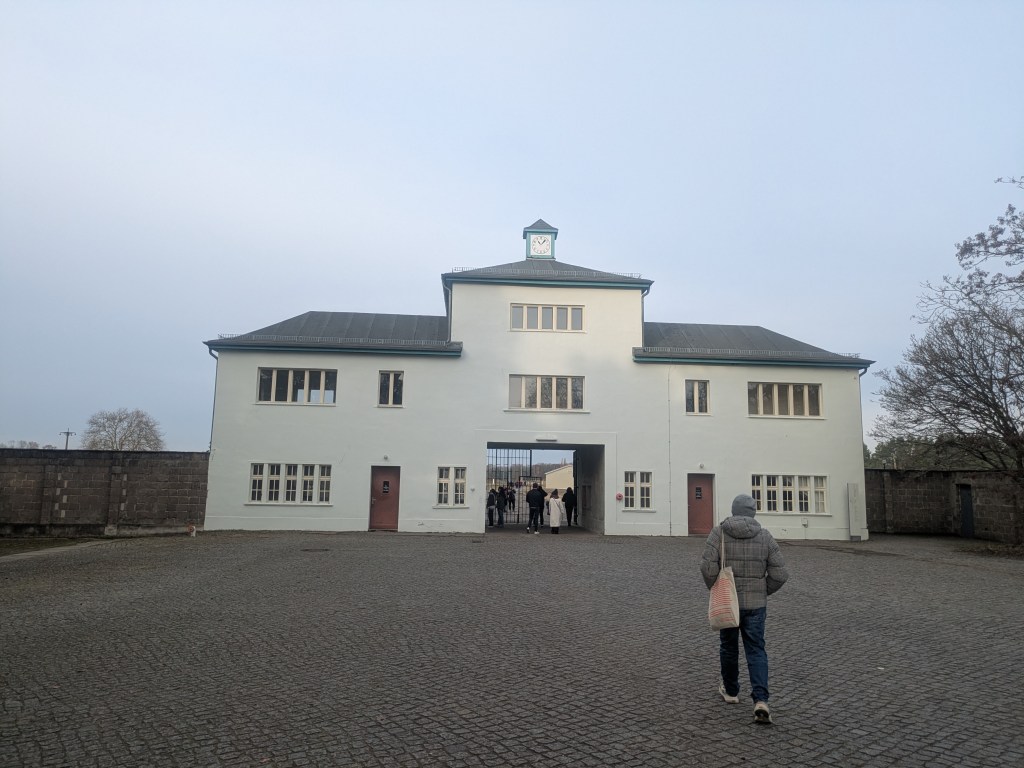
We successfully navigate the S-Bahn and head an hour north to Oranienburg and then walk the final 25 minutes to Sachsenhausen. We arrive with less than two minutes to spare for the only English-speaking tour, which is offered just once a week.
Sachsenhausen is a former concentration camp. When we planned this trip, two broad goals were to visit Christmas markets and to visit WWII sites. I am not a history person, especially a war history person, but in 2025 America, it is hard not to think that fragments of history are repeating themselves, that we are living through a time of violent, grotesque hatred. America is a place of rising deportations and private prisons, arrests and spilled blood, and if we were going to Germany anyway, I wanted to see what all the violence looked like in memory.
The camp is a combination of original structures and rubble. Upon liberation in 1946, many buildings were destroyed and they were never rebuilt. It feels like a kindness. To let ruins be ruins. To not resurrect buildings or manufacture terror for the sake of tourism. Several buildings survived, including the housing units of the Jews, Romani, and gay men. We tour one of them with our guide—a quick-walking Italian man who says every fact, every story in an even-keeled voice, never milking the trauma— most of which now contains plaques and artifacts for visitors to look at. The middle section has no signage. Cracked porcelain toilets lined against the wall. A broken tiled floor. Faded yellow roses lain across the seats. Our guide tells us that within housing units, hierarchies formed. A German Jew ranked higher than a Polish Jew, for example, and if you were gay, you were at the absolute bottom and forced to sleep here in the latrine. He tells us that men sometimes saved their children by volunteering their sons to work in the latrine. The piles of shit radiated heat and kept the boys warm in the winter, sometimes by a 30 degree difference.
Sachsenhausen was primarily a political camp and most of its residents were Soviet soldiers. It was one of the earlier camps established, a place where they tested some of the murder techniques they’d later perfect and implement at other camps. In the summer of 1941, over 10,000 Soviets were killed by gun shot to the neck. I later learn there’s a word for that: Genickschussanlage. A facility used for surprise executions. They often told the prisoners that they were going for a medical examination. Sometimes they even played music.
In the middle of the camp there is a gigantic pointed monument that the USSR built to honor its fallen soldiers. It has a sculpture of men at the bottom and the top is covered with red triangles, which was the identifying mark for Soviets. The monument represents the Soviet men killed here and no one else.
The camp is busy with visitors, and it feels strange to be a tourist here, strange that death camps are a place we all feel called to visit. Tall bare-branched oaks watch as we walk beneath them, the sky an insulating, somber gray. It is cold and windy. All of the guests are respectfully quiet.
At the end of the tour, we visit the gas chamber. Past the execution pit. Past the photos of victims mounted in the ground, staring out at us. Into the encased rubble we walk. Only the footprint of the building remains, the bricks marking the perimeter and the separation of rooms. Our guide tells us which rooms were what, and as we walk around the ruins, we pass the still-standing ovens, their chimneys their own monument of death. Roses are lain around the rubble. Yellow faded roses.
Our guide ends the tour right outside the gas chamber, and M and I cross the wintery camp again in near silence, the Soviet memorial watching us leave.
We catch the train back to Berlin, eat lunch, and then begin walking, trying to see some of the memorials and famous pieces of architecture before darkness settles. We pass through Brandenburg Gate, which is busy with Christmas revelers, and walk south to the Memorial to the Murdered Jews of Europe.
The memorial is a 4.7 acre site composed of concrete pillars of varying heights. At the edges of the site, the pillars are small, blending into the ground. They grow in size the closer you get to the middle, until you are swallowed by their size and shadow. We walk through the memorial in silence, the lights and noise from Brandenburg far behind us. As we walk, the ground gently undulates in small cement waves, so that we get lower and deeper into the memorial than we realize and the pillars soon tower above us like a forest of graves, and today has been so long and I feel sad and small, which feels stupid to feel when my life is nothing but fine, but I do, I feel that, and I don’t know what to do with all of this history, all of this grief, except to feel all of these things, and so I walk and darkness creeps in further and M walks somewhere nearby also silent, and when I type up this blog post weeks later, this will be one of the most impactful moments: walking in silence at dusk through the labyrinth of graves.
Miles walked: 11
December 7, 2025
Day 4, Berlin
We walk to the porridge place in Prenzlauer Berg, which I scouted on my second day here. The porridge is cheap, and we drink lattes and use WiFi while I journal and we plan out transportation. As a tourist flâneur, you must know your limits. How much will you walk and how much will you take transit? My legs are tired, and we’ve already explored a lot of the areas close to the hostel, so we decide to get a day pass for public transit with the plan of taking transit to other neighborhoods in Berlin and walking back at the end.
We take the U-Bahn south to the Mitte, where we were yesterday, and go to the museum for the Memorial of Murdered Jews in Europe, which is underground beneath the memorial. We’re screened by security before allowed to enter.
Like a lot of our trip, I didn’t do much research about the museum. I’d read it was four small rooms dedicated to the victims and that was about it. I figured it would be maybe an hour, a quick walk through, but I am terribly mistaken.
The first room is a timeline orienting the visitor to relevant history. I focus on the numbers. 70,000 killed in sanitoriums and nursing homes by doctors in the span of a single year. 146,000 murdered by exhaust fumes in Chełmno. Over 10,000 killed a day at Auschwitz. 140,000 dead from death marches and evacuations. Between 5.4 and 6 million Jews killed overall by 1945.
The next room is full of written records. Scraps of notes, postcards from victims, their last words to their families, to their journals, to whomever would listen. Like graves, the fragments of writing are entombed in their original handwriting on the ground, translated into both English and German.
Dear father! I am saying goodbye to you before I die. We would so love to live, but they won’t let us and we will die. I am so scared of this death, because the small children are thrown alive into the pit. Goodbye forever. I kiss you tenderly. Yours J.
There’s something about seeing the handwriting that undoes me, and I nearly break down sobbing in the room. My sister moves quickly through this room and into the next.
The next is photos and family history. Families from Hungary, France, Greece, Norway, and others across Europe. They show a family photo and note who survived and who did not. They give as many details about the family as they can, un-war related. Who they were before it started and who they were after. In some cases the picture is missing. In the blank space, the museum curators note that no one of this particular family survived, not even the mementos.
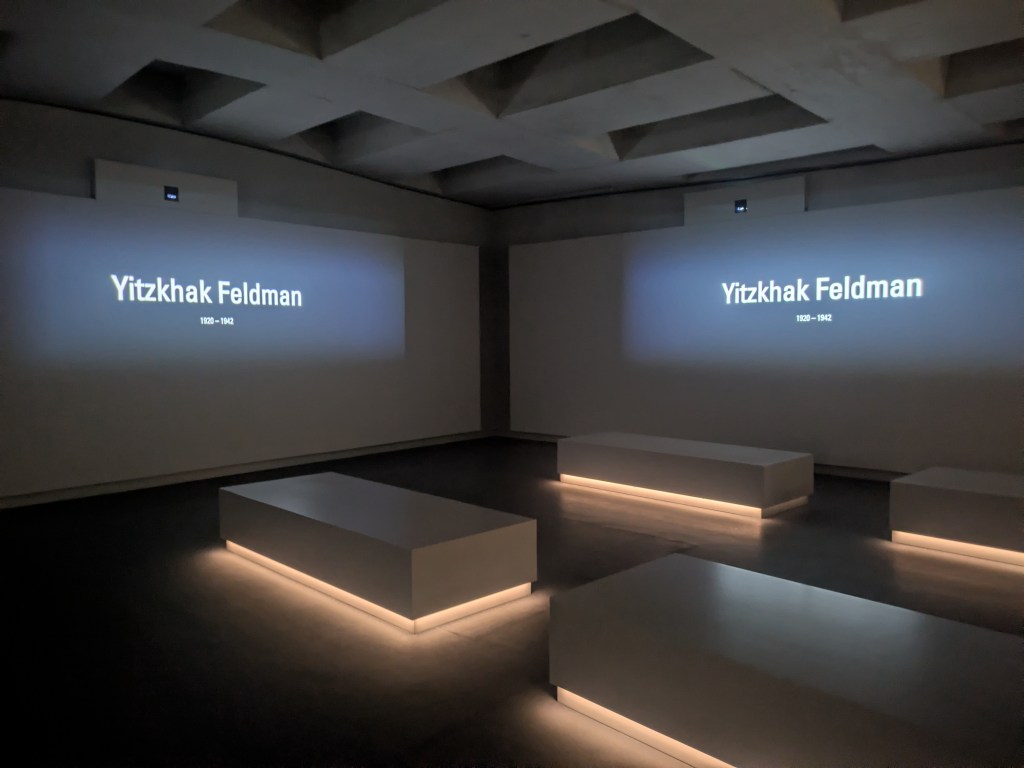
The next room is dark with long illuminated block benches reminiscent of the memorial above us. A name and dates of life are projected onto the walls and a narrator tells a story of that person’s life, once in German and once in English. If all the Jewish victims names were read, it would take about 6 years, 7 months, and 27 days.
Turns out there are more than four rooms, the final being some general overview about different death camps and one room dedicated to the survivors, videos and interviews displaying their stories.
I am emotionally exhausted, my feelings tender and bloody. I skim some of the plaques in the final room, unable to absorb more horror, but I pause by a picture. A picture of a plow collecting dead bodies that are strewn in heaps around it. Graphic and horrific by any measure. But it reminds me of another photo, a photo I’ve seen of the tanks in Gaza running over people, their mechanical treads grinding bodies into the earth.
At Sachsenhausen, in the remaining Jewish barrack, our tour guide told us stories of how the Jews and the other hunted fled looking for safety in any open arms. Country after country turned them away. Not enough money. Not enough space. Where would they live? How would they eat? It’s still happening now, our tour guide told us. In my country, Italy, in yours too.
It’s the refugees on boats and it’s the people in Gaza who are bombed and obliterated and fenced out of their ancestral home. It’s the recent violence in El-Fasher, Sudan, where the spilled blood and piles of presumed bodies were visible from aerial photos. It is the migrants in my own town who are rounded up and sent to federal prisons and shipped overseas without contact, without rights. Never again, people correctly say of the Holocaust, but for whom? At Sachsenhausen, once the Soviets freed the remaining prisoners, they took it over for their own use, imprisoning Nazis, anti-communists, and anyone else they wanted. At least 12,000 people died of starvation and malnutrition at Sachsenhausen under their control. The Soviets saw the horrors of the Holocaust, and they did the same thing. Less gas, less bullets, sure, but 12,000 people dead in five years is still 12,000 people dead. Is that the speed of human memory? That we can will ourselves to forget human horrors in less than a generation, sometimes less than a year, because the victim is not one of ours? Help me understand. Please. How did we get here, and how do we get out.
In the evening we visit the Topographies of Terror Museum, which is free and open late. It’s a huge building with an incredible amount of reading. The museum focuses on the history of the Nazis and the SS, charting their rise to power and the aftermath. I am not very interested in the lives of evil men, and I skim most of it. The part I read thoroughly is the aftermath. Who killed themselves rather than be held accountable. Who went to trial. Who is missing still to this day. Less than six percent of SS officers were successfully prosecuted. Some of them were released early because they were deemed too old to be incarcerated, which seems ironic in the most awful way.
The picture that lingers with me here is a former Nazi commander watering his garden. It is so horrendously normal. An old man and his garden. Just watering his flowers.
Because that’s the real ending, the one less impactful than Hitler and Himmler killing themselves. The real ending is that most of them got away with it. With it all. They went back to their families and to their normal lives and even if they had to flee the country, they survived. Many were given high up positions with the U.S. and other countries at the start of the Cold War. They lived. They got away. They murdered over 6 million people and had the audacity to shield their faces when they went to trial and then they resumed their normal lives and used their knowledge of death to help other countries torture other people. We toured the gas chambers, the pit where Soviets were shot in the back of their heads, and we learned about the people, the families, that didn’t survive, and the killers walked away. I think people like to mourn more than they like to take action. Grief is somehow comfortable and relatively easy. It asks nothing of us, only to witness. We will build monuments to the dead and tour their death chambers and we will write books and we will remember, but we do so little to prevent it from happening again. Thoughts & prayers & memory. But the day-to-day killers go free. The system persists.
Miles walked: 7
December 8, 2025
Day 5, Berlin
I find a breakfast place in Kreuzberg, and after a 30-minute bus ride and a 40-minute walk we arrive. It’s mediocre. There’s no English version of the menu and we can’t get the WiFi to work in order to translate it and the server seems mildly annoyed, the latter which is unremarkable since all Germans in service positions seem brusque.
After several days of museums and plans, our only goal is to walk and explore and make it to the medieval Christmas market in east Berlin. We go to bookshops and thrift stores and small clothing boutiques. We walk through a cemetery and see an old man sitting on his walker looking down at one of the plots.
We stop at Lidl, a grocery store, and stock up on European candy, namely Ritter chocolate. We’re both tired from walking, and so we head to a nearby Turkish cafe. I inexplicably get tiramisu, which is dramatically not on brand, while my sister gets two pieces of baklava. We sit and read and rest.
The walking continues. East and south, across the bridge, past the wall, down to the medieval Christmas market. Someone stops us and asks for directions in German, immediately switching to English when she realizes her mistake. It is always a compliment to be mistaken for a local, although I’m not sure why, what feelings ultimately lay under that rush of perceived authenticity.
Whereas all of the previous Christmas markets have been a bustle of lights and pop music, the medieval Christmas market immediately feels more calming, the colors and sounds turned down a notch. There are more handmade items here along with a miniature wooden Ferris wheel that a man pushes by hand. We think about getting some spiced wine or an authentic pastry, but we’re not really feeling it. We watch a fire eater briefly before heading out for the long walk home.
It begins to rain. Sprinkles at first and then sheets of wetness. We unpack the umbrellas from my backpack, but they only protect so much, the wind blowing water on my back, on the tops of my legs. There’s a long line of people in the rain waiting in front of the Uber Arena, which is right next to the Uber Eats Music Hall. The line stretches for blocks, hundreds of raincoat-clad guests huddled in the rain. We vow to look up who is performing that evening (answer: Radiohead).
The iconic painting of the two men kissing on the Berlin Wall is almost directly across from the Uber Arena. Like all cities, it’s an uncomfortable proximity of commercialism and history. I don’t think history should exist in a silo, but there’s something uncomfortable and sad about corporate-sponsored buildings in general, a sharp pivot from when buildings used to be named after philanthropists, a reminder that most aspects of our lives are up for sale and history is at the mercy of the powerful, even if the powerful is an app on your phone.
Miles walked: 13
December 9, 2025
Day 6, Berlin –> Prague
We wake up around 4:30 to catch the train to Prague. M and I agree that this is the most uncomfortable ride we’ve ever had. The seats are only lightly padded, and the Germans have this weird thing about facing each other, so you and the person across from you knock knees, not able to appropriately sprawl out. I feel excruciatingly aware of my legs. We switch to a bus in Dresden, which is also uncomfortable.
We arrive in gray-sky Prague and navigate to our hotel. A quick refresh and then the city becomes ours.
Even in the initial steps, Prague feels different than Berlin. The buildings are older, relics from different times and different architectural periods. Much of Prague lived to tell the tale where many buildings in Berlin did not survive the war. Like many European cities, Prague has a distinct Old Town where most of the important and dynamic buildings reside. It herds tourists into the same cobbled patches.
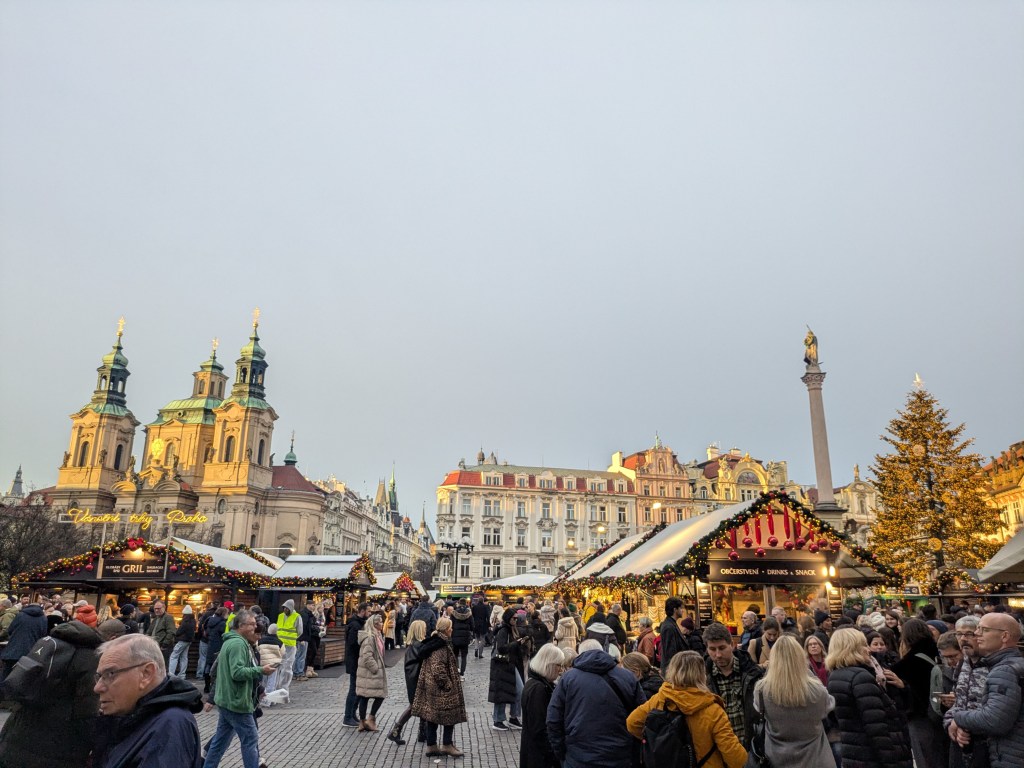
Old Town Prague feels embarrassingly picturesque. A huge cobbled square surrounded by dozens of distinct, beautiful buildings, none of which we know anything about, Christmas markets stalls and a giant tree all illuminated in the middle. Swarms of people are gathering outside one building, and we follow like good herd animals do, and find ourselves in front of the two-story astronomical clock. Exactly on the hour, a small skeleton starts yanking on the chain, which then opens a door at the top where all of the apostles file out. The show is rife with symbolism, which we don’t understand, and the clock as a whole is something only vaguely knowable to us. The show is over in about one minute, the miniature doors on the clock closing, trapping the wooden statues safely inside until the hour strikes again.
This is the first instance of Prague Tourists Looking, a moment when dozens if not over a hundred tourists gather in the same location to watch a small routine occurrence. For the clock, there was well over a hundred people, most of them filming the one-minute procession. I wondered if they’d ever watch those videos again and why did I care, and why do people feel that media they capture is somehow better, more personal than that publicly available.
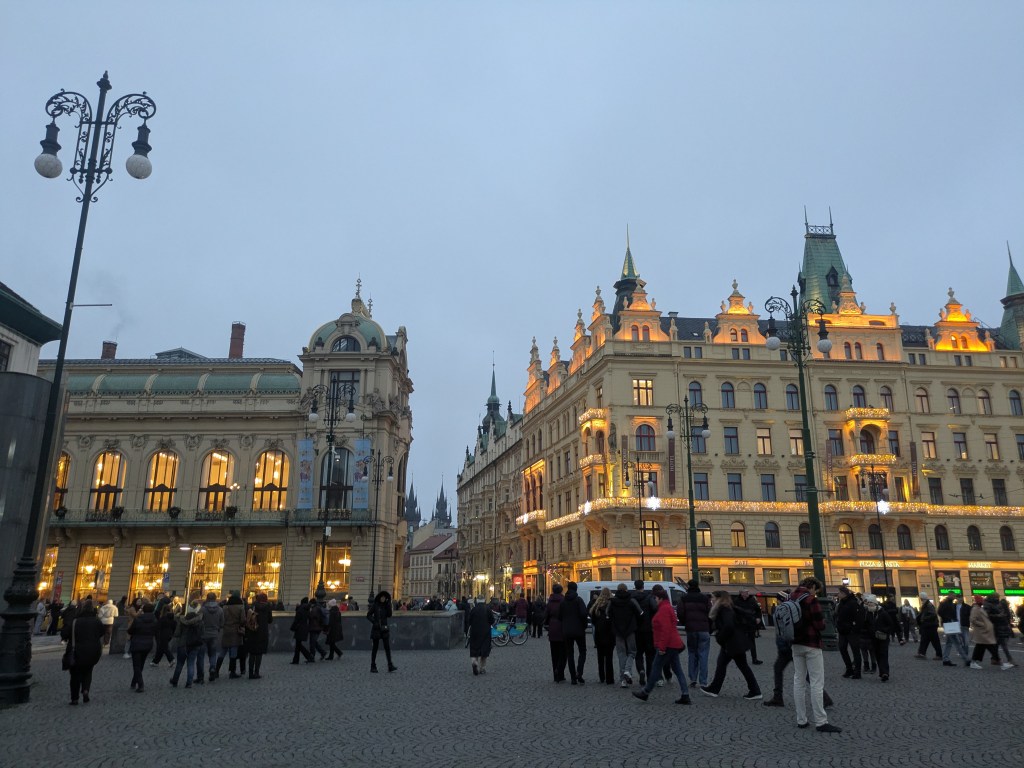
Dusk soon settles. Does this remind you of the Venetian? I ask M, referencing the Las Vegas casino. She agrees it does, even though the reference is absurd. But the sky is the perfect gentle blue-pink captured between the church turrets, just like the infamous casino ceiling. It makes me think of how a student once told me that to her the constant crash of the ocean sounded like traffic. I don’t think she’s wrong. We don’t get to choose where memory takes us.
The first day in a new place is always magic. You walk. You get lost. You see cool things and vow to look them up later and maybe revisit once you figure out what they are. It’s all about experiencing and not knowing, feeling the city out one foot fall, one glance at a time.
We eat dinner early at a fancy vegetarian restaurant, and it’s the best meal of the trip so far. We’re in bed by 7:30 PM.
Miles walked: 6.5
December 10, 2025
Day 7, Prague
Tour! We meet at an old powder gate tower promptly at 10 and begin our walk back into Old Town. Our tour guide is Hannah who is efficient and friendly. She’s a superbly fast walker, not unlike our guide at Sachsenhausen. We see one of the only cubist buildings in the world (it looks art deco, personally), and we also see where an American tourist got his head stuck in a sculpture for six hours until they cut the sculpture in half to get him out (bachelor party; why are we always embarrassing?).
We wait among the masses to see the astronomical clock again, and then venture west to the former Jewish quarter, a place we walked through yesterday with no clue to what it was. Most of it was razed and redesigned to look chic and Parisian when they were redoing the city center back in the late 19th century, and the lower shops now host stores like Chanel and Balenciaga. But tucked away into one corner is the oldest in-use synagogue in the world built in the 1270s. You can buy tickets to go inside, but for now we just look at it from the outside, hearing some of the stories that accompany it. Across the street is the Jewish cemetery. Hannah tells us that they ran out of horizontal space long ago, so they began stacking bodies vertically. It contains 12 layers of bodies, including the historic Rabbi Loew who defeated the Golem in the aforementioned synagogue. With 12 layers of bodies, the cemetery is elevated, and we stand below it, looking up through the iron fence at the crooked teeth headstones. The architect who designed the Memorial for Murdered Jews in Berlin was inspired by the headstones for his concrete pillars and it feels serendipitous that we saw both with minimal planning.
Hannah shows us a long line at the library. It’s for the book tunnel, she informs us. It’s a piece of art composed entirely of books that looks endless. It’s not endless though; the trick is mirrors. It went viral on TikTok and now there is always a line. She waves her hand dismissively. I’m not sure how quickly they are ushering people in, but it seems like you’d wait in line at least an hour for your photo. Another Prague Tourists Looking moment. I find this one particularly irritating because it doesn’t mean anything; you are taking a photo purely because it looks cool—there is no history, no significance—which is maybe what we do for all photos, but the virality for this one feels particularly lemming-like. Are we doing things for the photos or the experiences and does it really matter?
After the tour, M and I meander and look at things and remark at how devastating it must’ve been to go from World War I to World War II and then very quickly to Soviet occupation. America always feels like an unruly, spoiled child when you visit older countries, countries who remember suffering. America is vain, obsessed with its power, its baby-faced 250-year history thrusting its tiny fists for moremoremore. With the current administration, it is not hard to imagine that maybe our relatively good fortune has run out. That it is our turn to be destroyed as a nation. Maybe our years of darkness lie ahead.
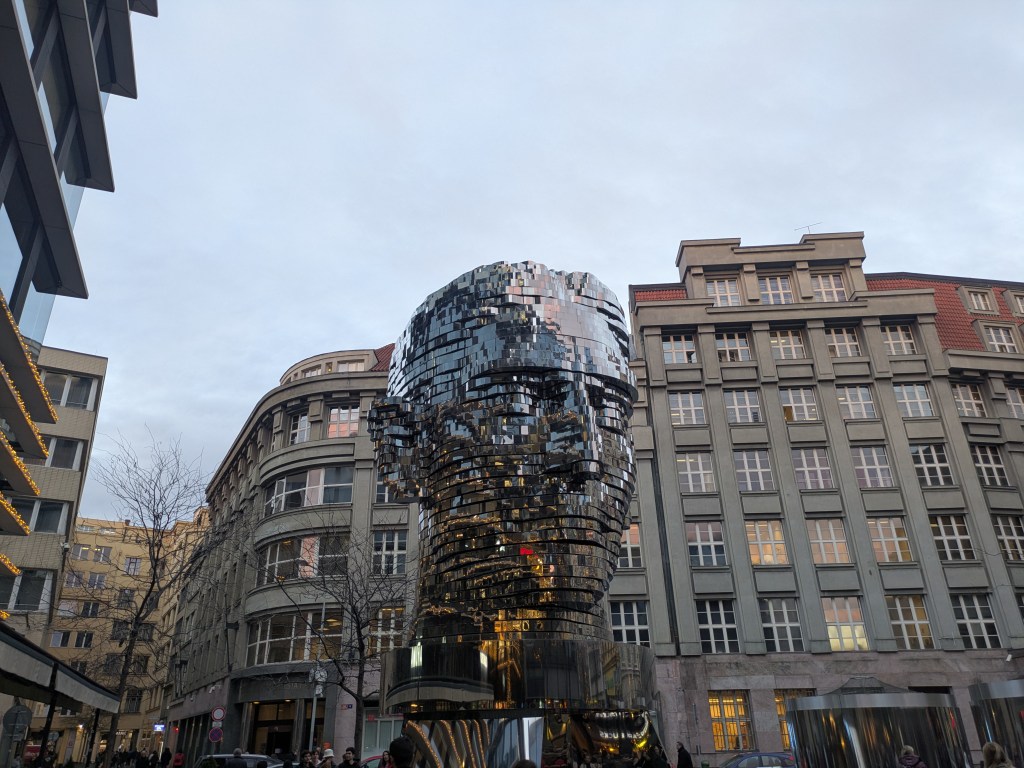
Our last tourist trap is the giant head of Kafka, which we only make an effort to visit because we end up close to it after wandering over the river. This is also a timely event. At every hour, his head turns. Not in one giant movement, no. The sculpture is composed like sedimentary rock, gouged and layered to form the contours of his head. On the hour, the individual platelets turn so for a time it is a jumbled metallic blur until they align once more, his gaze in another direction. It lasts for around 15 minutes, and, like the clock, there is a horde of people, cameras ready. Hannah told us that Kafka was shy and didn’t like attention, and I think he would’ve hated this based on the little I know of him. But I’m not really sure what a city, a country, owes its dead. His family was killed in the Holocaust. His work got famous after he died from illness. He never had any say in how the world remembered him, if he wanted to be remembered at all.
Miles walked: 8.3
December 11, 2025
Day 8, Prague
It’s our first time tackling public transit in Prague. Luckily it’s fairly easy, and we take the bus across the river over the the Strahov Monastery.
Strahov Monastery was founded in 1143, a Premonstratensian abbey, which is a denomination we have to look up (Catholic but not?). Our goal for this visit is to see libraries and drink beer (not at the same time).
There are two library halls in the monastery—the philosophical and theological. They are right next to each other in the same decorated corridor and you can peak into each, the doorway roped off barring entry. Entry into the halls requires a private tour. Too many people, too much breathing and moisture and sweat, would ruin the book collection, or so says the website.
We wait in a short line and then it’s our turn to take pictures of the philosophical hall. This is my Prague Tourist Looking moment. Both libraries have painted ceilings and thousands of volumes of books, several of which are displayed openly in the corridor carefully enclosed in glass, but there are no plaques or further readings of what I’m looking at. While we are looking into the theological hall, a door opens on the far side and a woman walks through. She walks slowly across the hall carrying a roll of toilet paper, and comes through the entry we are stationed at. M and I find it hard to believe that this was the best route of travel for her. People can just casually walk through the halls to bring janitorial supplies? Strange.
I get my pictures like I wanted, but I don’t feel as much as I’d hoped to. They were pretty, sure, but I wanted something more, a feeling of transformation, of awe, of dipping your toe into a beauty and wonder that does not exist in your day-to-day life. But this is how the Prague Tourist Looking moments work. You can get a little taste for the beauty, for the history, but any more and you’ll be charged gratuitously. You get a picture, not an experience. I don’t begrudge the cost of everything, but coming from Berlin where almost everything we did was free, the difference is notable.
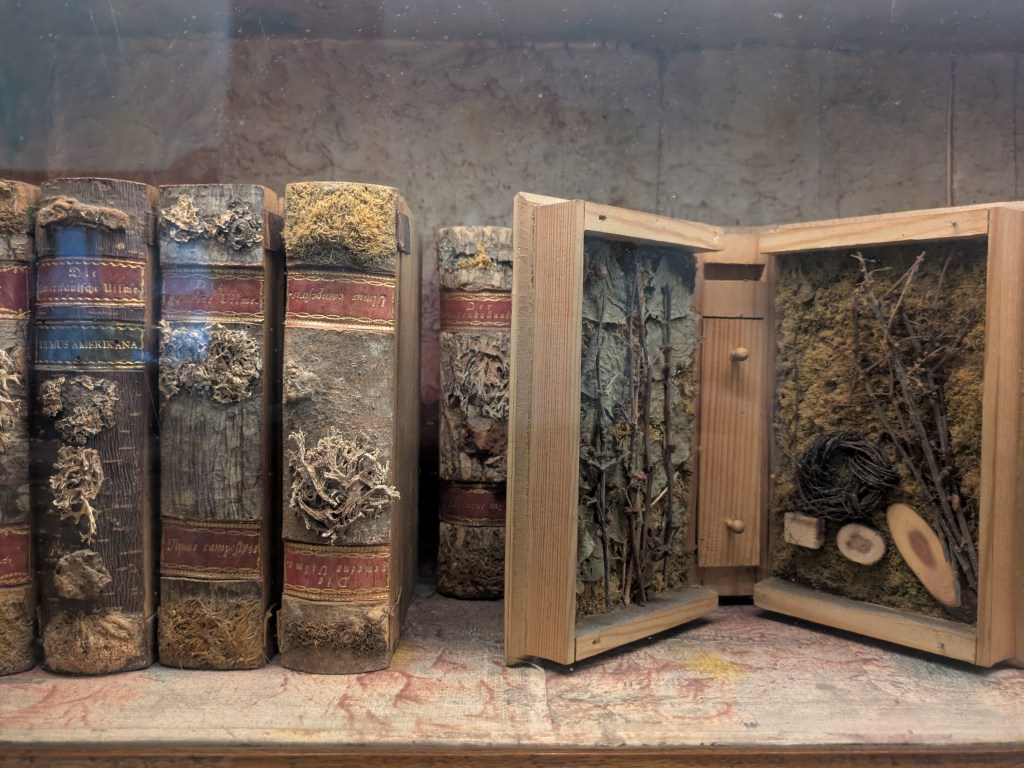
I find the most excitement in the corridor connecting the libraries, which houses the Cabinet of Curiosities, a collection of gathered objects from a singular baron in the late 1700s. In one cabinet is a collection of wood books. Xylotheque, the sign reads. Dendrological library. Each book is made from a tree, the spine bark, splotches of lichen gripping to the sides. Several of the books are propped open, showing the leaves, branches, and other gathered tree matter carefully preserved inside. A tree library. I am thrilled. Here is the magic I was looking for. Who knew this existed? This type of art, of preservation? As I grow older, my biggest fear is that I will feel less moved by the world around me because I’ve lived and experienced so much. It sometimes feels harder to find novel, illuminating moments that wrench me out of my daily existence, but here it is, a tree library tucked away in a monastery in Prague, and there’s been a lot of moments like that this past year, moments of new knowledge, of learning about something I had never heard of before and how that discovery sometimes feels just as thrilling as finding a patch of purple wildflowers or a rock-clinging sea slug, that it doesn’t always have to be mountains that change us.
We go to the brewery afterwards, which is located and run by the monastery. We sip beer and eat pretzels dipped in whipped cheese and scallion sauce. I catch sight of two men across the beer hall who look vaguely familiar, and a memory unearths of my time in Pittsburgh and a guy I briefly dated, and I am positive that these two are his college friends. It is bizarre seeing them here in Prague over 10 years since I last saw them, and I think if this moment occurred when I was younger, I would’ve had more feelings about it, the symbolism would’ve been heavy, but at 33, they are people from a past life, and it all means nothing only that time moves on and so do we.
We spend the rest of the day walking. Prague Castle, the Charles Bridge, a gingerbread shop, a book store, a vegan restaurant with Suicideboys playing in the background. Like every evening, we end up in our room well before 10 to read and scroll on our phones and look up all the questions we had throughout the day.
Miles walked: 7.5
December 12, 2025
Day 9, Prague
Last full day for M!
We catch a train at the very busy Prague terminal, which feels more like an airport than a train station, and head to Kutná Hora an hour away.
The weather is how I imagine most Eastern Bloc winters must feel—gray and foggy, the landscape passing by the windows like a dream. California is bright. It is fragrant and colorful, and I understand why it’s a global destination, but as we disembark and walk through the fog and the sparsely populated streets, I find this beautiful too, the monochromatic solitude of the town and the weather, how everyone is bundled and wrapped, and everything feels distant and unknowable like you’re walking through a memory that you’ll never inhabit again.
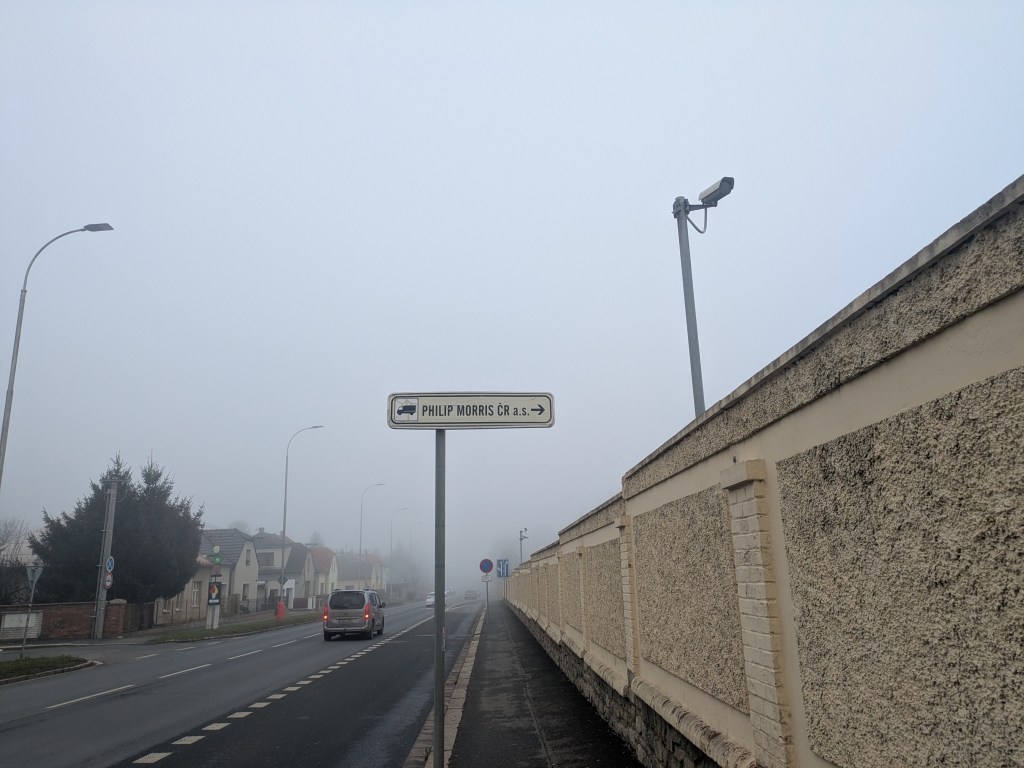
We’re in Kutná Hora to go to Sedlec Ossuary. On our walk through town, we pass Coffin Coffee and several shops that sell skeleton and bone souvenirs. We also pass a sign for Philip Morris and a large guarded gate. The tobacco company? I ask M. She’s unsure. I look it up later and it is in fact the tobacco company, proud parent of Marlboro and Zyn.
The Ossuary bans photography, citing that too many tourists were disrespectful to the dead, taking photos of the bones and selfies with smiles, disrespectful in a place of death and worship.
The history is something like this: Tens of thousands died because of famine and then because of plague then war, all buried in the same plot. Hundreds of years later, their bones were exhumed and used to make the gigantic pyramids, chandeliers, and coat-of-arms that now decorate the ossuary today. There are about 60,000 people represented in the bones contained within Sedlec. Skulls and femurs construct four giant pyramids. Ribs and vertebrae and a sundry of others form a large chandelier beneath which lies the entry to the tomb.
All of the readings play on optimism. It’s not a death cult, they read. It’s symbolic of resurrection, of being closer to Heaven, to God. I am not a religious person. There is nothing personal to me about churches or God. As we leave the ossuary and pass Coffin Coffee and Philip Morris International, I can only think of the dead. The dead of Sachsenhausen and the Memorial to Murdered Jews and the dead here at Sedlec and the dead not even acknowledged that lie buried in the corporate history of Philip Morris, and I don’t know what we owe the dead, what honor and compassion looks like, whether we resurrect buildings or leave them in ruins, whether they deserve a memorial or to be bones in a pyramid or stacked 12-layers deep in a grave, and it’s interesting whose death we acknowledge and whose we don’t, how it’s OK that the bones of peasants at Sedlec are used to form a wealthy man’s family crest (who were they? how did they die? what did they dream about and want from life and whom did they love?) and how if that same object was at Sachsenhausen the accompanying feeling would only be revulsion, and in a world of limitless news and limited attention, who are we forgetting, whose deaths don’t make the cut, and what does respect for the dead even look like any more, and what does it mean that you can’t take pictures but you can buy a bone-shaped pen at Sedlec and that Sachsenhausen has a gift shop, and I think we want the pictures and the souvenirs more than we want the feelings and the memory, that we want something palatable and small, but we don’t want to sit with the large atmosphere of it all, we don’t want to handle the complications of what it means to be a killer or to be the killed and how none of this history is over, and how we are still living it, feeding it, and when I started this post, I thought I’d write more about Christmas markets, but some things change and some things never do, and I am still a person who thinks about darkness more than anything else and that was true when I dated that guy in college and it’s true now, wedge-shaped core of darkness, Virginia Woolf wrote, and she was right, she was right.
Miles walked: 7
December 13, 2025
Day 10, Prague
M leaves at 3:30 AM, and I am alone. I take longer at breakfast and catch up on journaling. I watch YouTube until about noon when I finally decide to head out.
All I do is walk. M did most of the navigation for Prague, and it’s impressive how lost I get, how the winding streets don’t lead where I expect them to. I walk and eat and read and write and let the feelings settle. The day passes.
Miles walked: 11
December 14, 2025
Day 14, Prague–> California
Walking, bus, airport, plane, more airports, more planes, more waiting, more walking.
A couple near me on the plane breaks up before we leave the tarmac but are seemingly together by the time we disembark 11 hours later. I watch A24’s Sorry, Baby, and read The Trio by Johanna Hedman.
We get to San Luis Obispo airport around 9 PM, and then I walk to my car parked a mile and a half away. And then I drive home.
And then it’s over. Just like that. I wake up and put the final touches on a grant application before submitting it and life goes on, just like that.
When people ask me about my trip, I tell them mostly about the Christmas markets and less about the dead.
Miles walked: 4
 People in Parks