Another journey in the outdoors. Trying to get outside more, trying to write more. There & back again. For HCV 5725. For Terry Tempest Williams.
Day 1
Day 1 is 15 hours of driving. It was supposed to be 12 hours of driving and spending the night in Salt Lake City, but instead it’s three hours more and I only make it to St. George. A truck carrying giant lithium batteries overturns on I-15 and the thruway suddenly closes. Everyone gets pushed onto the 40. It takes me eight hours to go 132 miles, cars inching across the sweltering pavement. It is 110 degrees outside and my car doesn’t have AC. This is my fault. I refuse to pay and get it fixed. It builds character, I tell myself and those who will listen. It really makes you feel a part of the environment; you’re not just traveling in an air conditioned box through the desert. You’re actually a part of the world around you, experiencing it all.
I sip water the temperature of tea and listen to music and eat Larabars. The desert starts to feel apocalyptic with cars overheating on the side of the road and the few and far gas stations start running out of gas, their entry lines literal miles long. A man pulled over on the side offers me a cold water bottle as I inch by. He hands it to me through my open window.
I was planning on camping, but finding a spot is more energy than I can manage. I get a hotel room for $70, swaying from dehydration and hunger as I check in, the woman looking at me strangely. I don’t think I paid for a single room in my 2017 three-month camping trip, and this fact feels emblematic for how much has changed.
Day 2
I wake up stiff and dehydrated. I continue driving.
I arrive in Salt Lake City and it begins hailing. My two goals for this road trip are to visit my friend in Wyoming and to see the Great Salt Lake. A recent study said that if dramatic action isn’t taken soon, the Great Salt Lake could cease to exist within five years. Five years. That’s it. It’s partly due to climate change, but mostly due to over pumping water, specifically for agriculture. There are so many natural features vanishing before our eyes, and it is a strange feeling to be alive on the brink of collapse, living through the tender moments of abundance when we can still experience what exactly we’ll lose. Most of life, it seems, is saying goodbye.
The heady feelings begin as I drive the isthmus to Antelope Island, which used to be an actual island in the middle of the Great Salt Lake, but due to the water’s extreme recession, is now connected by both man-made isthmus and lakebed. The smell of sulfur and salt fills my car. Shorebirds fly overhead and paddle their way across the water. There’s a moment when road trips begin to feel magical, when you’ve driven far enough that land is new and exciting and your mundane problems no longer feel relevant. Your skin sheds, and you are made new, a child of the horizon and the wind and the uncertain tomorrow. This is that moment.
Gray clouds fill the horizon, and I watch them roll in quickly from my campsite. I sit in my camp chair as the winds pick up and thunder rages overhead. The wind blows and blows and blows, and I shield my eyes from the flying sand, the tumbleweeds, but I stay outside because this feels like initiation, the first intimate moment with the Great Salt Lake, and I want to feel connected to the world around me, more than a mere observer. So I stay until the winds give me a headache, and then I slip inside my car and let the wind and rain pummel us.
There are spurts of wind throughout the evening, so I sleep in my car. Back again. Just you and me, old chap.

Day 3
I wake up and shove granola in my face along with the last few LifeSaver gummies. Eventually I feel awake enough to make instant coffee, which I sip while watching a kestrel hunt in the tall grass and a western spotted orbweaver wrap a fly caught in its web. I read by the lake and feel sluggish all morning.
In the afternoon, I venture into the city. The most interesting thing I see are the billboards of Julia Reagan that dot the highways, the streets, everywhere. In memory of Julia Reagan, they read. Wife, Mother, Grandmother. I assume she’s some prominent Mormon figure, but it turns out that her husband owns the billboard company, and when she died he bought 30 boards in the city and 300 nationwide and plastered her face and memory on all of them. He says she was shy and would’ve been embarrassed by the gesture, but she died unexpectedly and he never really got to say goodbye. Seeing the billboards all over, he says, gives him another chance.
Back at my campsite, I think about California. I like being on the road, being here, but I also miss my small life back on the coast. That is something else that is new, this settledness, having something to miss. My 20s were go-go-go, always moving, always leaving, and now I’ve lived in the same apartment in Morro Bay longer than anywhere else, except my childhood house.
I miss my boyfriend, and in my missing, I write him a letter. I include a Rilke quote, which I only find out later that I’ve misattributed (it was mid 1600s Andrew Marvell who wrote that iconic line; who knew). I never get the chance to give him the letter.
Day 4
This morning I swim in the Great Salt Lake. Well, kind of. I float. It’s 9 AM on a Monday and I have the beach to myself. Flies dot the surface and brine shrimp hang suspended in the saline water. I think of Terry Tempest Williams and her book Refuge and how she details her time spent at Great Salt Lake, a childhood spent swimming in its salty waters. In the 1990s, the problem was that the lake was flooding, its waters pouring over roads and encroaching on developments. Two of the proposed drainage methods were dying the entire lake purple to accelerate evaporation and to nuke it (but for real; those are genuine ideas that legislators in Utah discussed). And now here we are, the opposite problem at hand. Five years. Five years left if something isn’t done.
And then I’m driving once again. I get a charcoal and rose latte in Ogden, I do some quick grocery shopping in Twin Falls, and I arrive in Yellowstone at 7 PM on the dot. The last hour and a half of the drive is exhilarating. The yellowed, flat landscape suddenly morphs into a land rich with douglas firs and rivers and high elevation wildflowers. It is so green. I get the same kick of energy as I did driving to Antelope Island—finally, something new and wild. California is so monochromatic this time of year, everything just teasing the fire gods for a light, and this green, these trees, these bloated rivers, withhold some taste of home.
I reach my friend’s place and we go for a sunset walk. At a curve in the trail, there’s a vast meadow beyond, and my friend stops me in my tracks as a grizzly walks out. She is far away and we are safely hidden on the trail, but we stop and watch as she saunters across the meadow. And then cubs! One, two, we only see two at first, but then a third appears as well, and the family plays in the meadow, poking their snouts into the long grasses and rolling around on the hill. And one point, one of the cubs just sits on the slope and watches his family play beneath him, and it is so scenic and lovely and I wonder if animals have any sense of wonder, of beauty, if any part of their brain can process the enchantedness of it all.
Day 5
Today is a hiking day. I ask my friend for clarification on the difficulty, and he says it’s not very long but it’s all uphill. This is good to know. I am in incredibly mediocre shape, but I also know I can do hard things, so I feel like it will be fine.
He did not lie. It is all uphill. It is not only steep, but Yellowstone is also entirely at elevation, and my weak little sea-level lungs are getting quite the workout. It is difficult, but comfortably so.
Less comfortable is the bison we come across. He was sleeping near the path and he is not happy at being woken up. He begins snorting and we quickly back away, giving him space. He eventually leaves and we continue on, through a meadow of fireweed, through the trees, up and up.
And then we find the first relic we are looking for—a petrified tree. I have never seen a petrified tree before, and it takes me a little to figure out what I’m looking at. It is somehow both tree and mineral at the same time, the rings from the tree clearly visible, but the stump is hard and crystallized. One even has a geode crack running through it. It was a regular tree once—a redwood, a maple, a magnolia, something that would no longer survive in Yellowstone’s current environment—that was suddenly covered in volcanic sludge. It was special sludge, though, rich in calcite and silica, and the sludge traveled through the hollow tubes of the tree trunk and slowly solidified it, and now we have this surviving artifact of plant life 50 million years ago.
It is curious what lasts. The Great Salt Lake is only 11,000 years old and yet it may not see the next decade. And these petrified redwoods lived among dinosaurs and yet they are somehow still here today. In a different form, yes, but still here. And maybe that’s the secret to it all. Maybe everything has to change to survive.
The day continues on, grand and expansive. We see more petrified trees and thousands of bison. I keep my eyes peeled for any flashes of white among the herds of bison, hoping to see a glimpse of the white bison calf who hasn’t been seen in six weeks. The chances of a white bison being born is about one in one million, and the sighting of this bison fulfilled several tribal prophecies. But she was very young during her first and only sighting, and about one in five calves die each spring, so maybe that glimpse is all we’ll ever get of her. She was alive at one point, and then she was gone. Maybe that’s how the story goes.

Day 6
Mini road trip. I can’t find my headlamp, and I feel like a messy, disorganized person. I spend the morning calling my bank to dispute a fraudulent charge someone made through my REI account. $134 for a hydroflask? Not in this lifetime.
We drive to the Tetons and go to Taggart Lake. My friend naps and I read the final installment of The Broken Earth trilogy, which rightful deserves to be a three-time Hugo Award winning series. The series is sci-fi and has to do with changing environments and fracturing earths, and it reflects my road trip experience to a remarkable degree. Yellowstone is hilly and rich with valleys, but despite being surrounded by incredible mountain ranges, there are no real mountains in the park. Turns out they all blew up with the volcanic activity. Who knew. A couple of the trees made it through, but the mountains did not.
We eat pizza in Jackson and pick up some next-day snacks at Whole Foods. It is insane to me that a pizza in Jackson is cheaper than in Morro Bay, where I live. My sister and I visited Jackson in 2017, and I find myself looking at all the buildings, the quaint shops, thinking we went there; I remember this. I’ve been more nostalgic lately, both on this road trip and in life, and I’m not sure it really means anything besides the fact that I’m getting old and there are more past selves than there used to be.
I stay up late and finish my book.
Day 7
Moose! We see five moose at Moose Pond (very aptly named), three females and two calves.
We picnic by a river, and I eat spring rolls purchased from Whole Foods the night prior along with an entire carton of blueberries. My friend eats dates and peanut butter.
It is here that everything clicks, and I suddenly don’t want this trip to end. In the beginning, I was enamored and thrilled by the adventure but also gently missing home, and now I want to keep driving and camping and exploring and go go go into the vastness. There is so much world to see.
Day 8
I leave without much fanfare. See you in the fall, hopefully. Yeah, maybe. Life just resumes. So it goes.
I blast Britney as I drive westward, her whole catalog of hits. Britney and Chappell and Olivia and Spice Girls and all those full-throated pop songs that make you sing-scream into the windshield. The drive is dry and dusty and there are a lot of advertisements for potatoes (Idaho!).
There are also many signs for Idaho National Laboratory. The signs are not explicitly clear what it’s all about, but it definitely involves energy and it definitely involves nuclear. It makes sense that something nuclear-related is positioned here in the desert far away from mass civilization. In Refuge, Terry Tempest Williams writes about all the atomic testing the government conducted out in the desert, detonating bombs far away from civilization, believing that the absence of direct contact would make their actions OK. Turns out “far away” is a relative idea and that the wind doesn’t care and that certain communities in Utah have suspiciously high cancer rates, including her own family where eight women—her mother, grandmother and six aunts—have had breast cancer.
I drive through Arco, which proudly claims to be the the first city in the world powered by nuclear, and make it to Craters of the Moon. It is very hot. About 100 degrees. And Craters of the Moon is endless lava rock with no shade in sight.
There are only two caves open due to the proliferation of white nose syndrome among bats, and I go in each of them. They are both lava tube caves, which is kind of self-explanatory. Neither are dark enough to need a headlamp thanks to all the skylight openings in the rock. Indian Tunnel is the longest at 800 feet, and I walk through it, up and down the rocks, until I get to the end, which you crawl out of. Instead of leaving, I turn around and find a high rock in the middle of the cave where I sit and watch the pigeons that fly in and out. I sit and sit and sit and several groups pass me by, and I think about caving in West Virginia, and how that Halloween weekend when I was 21 was one of the most memorable moments of my life, and maybe that’s what life is about—new experiences, new landscapes, moments that thrust you out of ordinary life into the beyond.
Eventually I leave and head back to my campsite, where I reread the 2020 Pitchfork interview with Fiona Apple that’s saved on my phone and eat runny mac and cheese. I sleep in my tent without the rainfly. The stars are brilliant.

Day 9
Penultimate day.
I begrudgingly drive south. I want to stay up north, in Idaho and Wyoming, head up to Montana. The road trip rhythm finally settled in me, but now time is up. I could eek it out until the very last day, but I also know I’ll be upset with myself if I don’t have a day or two of transition time back to normal life. My sister and I often discuss how travel is a function of time and money, and it’s hard to have both in surplus.
I drive and it’s still hot and I listen to Britney again and the high of the trip is leaving me. I start thinking about work and all of the menial tasks I need to do to keep myself alive, and part of me contemplates getting a motel for the night because I’m tired and sometimes finding dispersed campsites stresses me out, but it’s the last night and I still want to feel wild, just for one more night, just for one moment longer.
The Julia Reagan billboards are still there; they smile me onward.
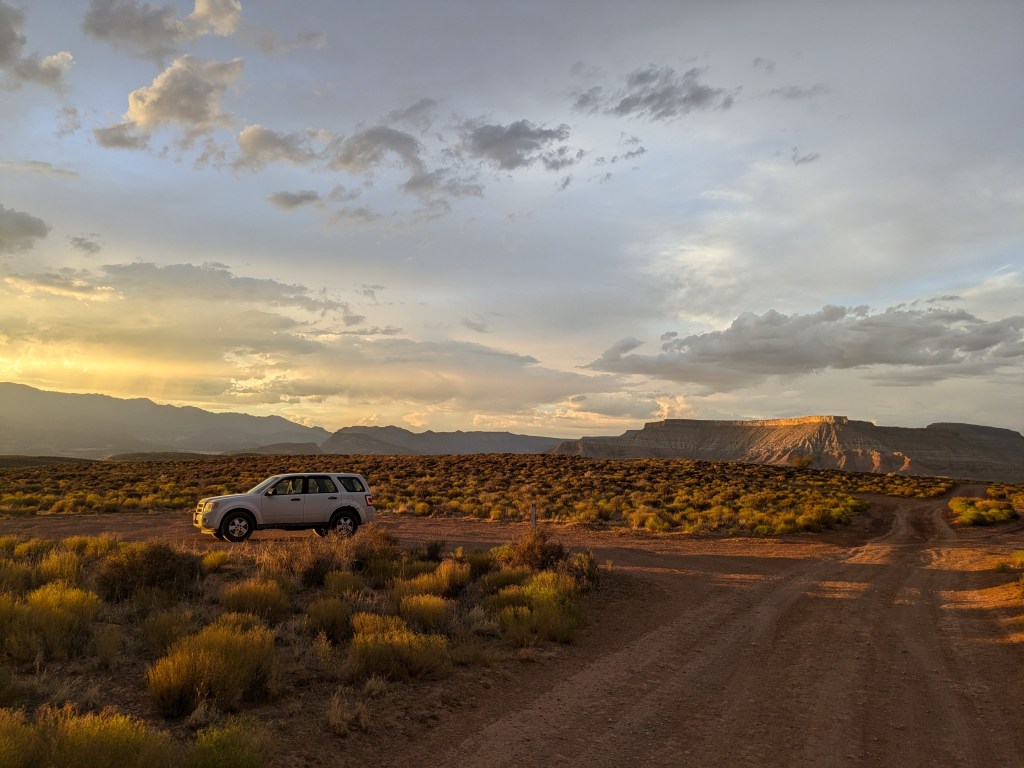
I find a spot outside of Zion, and it’s incredible. It is sunset and the mesas are glowing in the fading light. I park my car and run a little down the dirt path, feeling the openness of it all, the complete absence of people. I drink a fancy seltzer water and eat a fruit cup and just watch sunset. It is so so beautiful.
I cowboy camp for my last night, which just means sleeping on the open ground. I can’t fall asleep for some reason, so I stay up late reading on my Kindle. Every so often my eyes jump upwards to watch a shooting star, the beginning of the Perseids most likely.
Day 10
And that’s it. I wake up and I drive drive drive and by the time evening rolls around I am back in my apartment on the coast with the fog rolling in. This is the only day of the trip that I don’t journal.
I stay in bed the entire next day, and then I grocery shop and do dishes the day after that, and then I am back at work having meetings with coworkers, the feeling of my sleeping bag and the snorts of angry bison and the smell of alpine forest slowly receding into memory. It is scary how quickly it all disappears. How the daily minutiae settles back in effortlessly, no resistance, no fight.
It is funny how much life you can live without anyone else ever really knowing. Sometimes it is tempting to keep everything to myself, but there’s something about preserving and sharing memories that also feels uniquely special.
So here you go. Here’s a written record, something to keep the memories alive a little bit longer. It won’t last 50 million years or even 11,000, but it’ll do for now.


Leave a comment