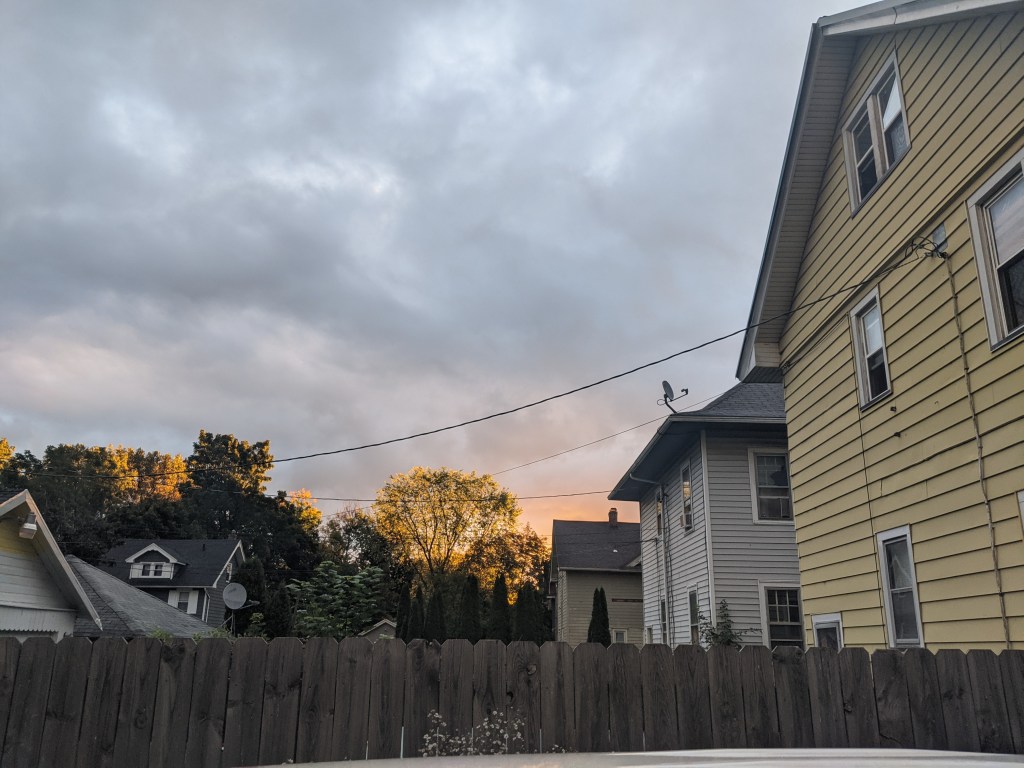
• Sunrise before the commute.

    It’s because of mercury, one of my coworkers tells me in the staff room. It’s in retrograde? Something like that. I saw it on social media. That’s why the kids are acting like this.

    Full moon’s tomorrow, a different coworker says a week later. Another teacher shakes her head. I don’t know what to do with them.

    The other week, two fights broke out before 8:30 in the morning. Two boys came off the bus and immediately started throwing punches. The other happened in the cafeteria while students were finishing bag check and going through the metal detector, all 200-something of them clustered in the dingy room. I was in the cafeteria when it happened. It was my week to be on bag search, meaning I show up 15 minutes early, stretch on a pair of vinyl gloves, and paw through students’ bags searching for contraband, mainly cellphones. I hate bag check. It feels invasive. I stick my hand in gym shoes and open purses and remove study Bibles searching. I usually don’t know whose bag I’m looking through, and sometimes the contents make me wonder who they are. A narrow slice of life. It is like looking through someone’s illuminated window when you go walking at night. A glimpse, no more. An introduction made solely on a handful of objects.

    But I digress. The fight.

    I was finishing bag check when it erupted behind me. There were bags on the floor and a swarm of kids just loitering and it was hard to tell what was happening. You know a fight is breaking out based on how everyone else reacts. It is like the way tides wash out further before exceptionally large waves, a physical prelude to the coming violence, a brief warning if you are smart enough to heed it.

    I’ve never been in a mob before. The intensity electrifies you. Students began surging toward the fight, running across tabletops to get closer to the nucleus of it, pushing and yelling, bystanders getting roped in. I helped a girl off the ground who’d been pushed over in the swarm and she was smiling. Smiling.

    It lasted only a couple of minutes before the students were forcibly separated and everyone was sent to class.

    The fight was over a student calling another student gay. Something of the sort.

    I had study hall in the cafeteria first period that morning. My thermos had been knocked over by kids vaulting over the tables, and I spent the first five minutes cleaning it up. And there it is. The picture, the symbol, the metaphor stretched thin. Me in my coral-colored dress sponging off spilled tea. My orangutan thermos lying in a puddle on the ground. My book on social inequity in Aspen a little damp but not ruined. The bottom of my laptop wet. The remaining kids were silent as I worked. The silence after a fight is volatile—it threatens to break at any moment.

    The atmosphere of violence that permeates my students’ lives is unfathomable to me. During our nonfiction unit, my creative writing students wrote about rape and abuse and their dads being murdered by gang violence. Multiple students in my school have been in jail for things they did and did not do. In September 2020, one of the largest mass shootings in Rochester happened at a backyard party, and apparently a handful of our students were there. I get it, I want to tell them. I get it that learning the correct use of apostrophes is the last thing on your mind, the least important thing I could teach you. I get it, I get it, I get it, but really I don’t get it at all.

    I don’t believe it’s the full moon, and I don’t believe it’s because Mercury was in retrograde. These things are happening because we have failed these kids. We as in the schools. We as in their social structures. We as in public infrastructure and EBT cards and health care and the fact that one of my students used to wake up at 4:45 to skateboard to school because none of the buses went near his house. The bones of our fractured society are being unearthed in the pandemic, the debris we’ve buried washing up in the rain. None of my students are bad kids. They don’t deserve any of this.

    In my department meeting the other week, we discussed which students were eligible for reading intervention. Most students read well below grade level and there are several burgeoning programs in our school that provide literacy support. There are a couple problems, though. First, kids don’t want an extra class, especially one that focuses on something they are bad at. Second, there are not enough teachers and not enough rooms to support these extra classes. So the department has to choose. They have to choose who qualifies for these services and who doesn’t. Based on shaky diagnostic data, some students will have access and others will not. And I’ll spare you the grisly details, but in summary it’s educational triage. We can’t help everyone and some of the students the department is helping are those who are deemed to have the greatest chance of success. I don’t know what to do with this information.

    I asked some of my grad school peers about these issues the other week. What do you do about high absentee rates? What do you do about the behavior? What do you do when in a single senior-level class you have reading levels from grades 3-12? What do you do?

    My advice would be to go with your gut, one of my peers said. You’re doing your best. It was kind of her to say this, but it was useless advice, the kind of live laugh love statement that sounds pleasant but is entirely meaningless. My gut isn’t good enough. I want proper trauma training. I want to know what to do when my students tell me they’re hungry. I want my school to have a library and a gym and a computer lab—all things it currently lacks—and I want to know when I should be generous with their needs and when the right thing to do is tough love.

    It is fall. There are black walnuts along the canal path and egrets in the river and a fist-sized hole in the stairwell window screen that grows wider with every passing week.

    I’ve been working on metaphor with some of my students. Love is a BLANK. Fame is BLANK. They find it hard to write in abstracts, to move beyond cliches.

    School is a prison, most of them wrote on the assessment. I don’t entirely feel like they’re wrong.

  • Everything you know about Aspen is true. Everything and more. Calling it a small Colorado ski town is like calling a humvee a car—you’re not wrong, but you’re not really right either. Aspen is a town wedged into a northward-slicing valley, mountains cradling it like arms. Everything about it is pristine, from the level sidewalks, to the sharply mowed lawns, to the women who walk to their dinner reservations clad in heeled boots and faux mink wraps. Only people with trust funds would dare call Aspen quaint. People’s elaborate mailboxes are probably worth more than some people’s annual salary.

    I taught environmental education there and it was wonderful. Kids and trees and dirt-scrubbed fingers. It was wild in the way a town where the average house price is 2.3 million is wild—wild but contained. Kids-aren’t-allowed-to-climb-trees wild. Wild in the pristine, palatable sense.

    But that was then and this is now. Now it is late September, and I am back in New York. It is my third week teaching, and on most days I feel like I’ve been hit by a bus. It is chaotic in the predictable ways that teaching inner-city high school during a pandemic is chaotic. It is probably chaotic in the years when the world is not reeling from a global health crisis, but everything this year is turned up to an excruciating degree, the pegs turned just enough that every string is on the cusp of snapping.

    I am not overwhelmed by the minutiae. I do not stress easily. Rather, it is the big picture stuff that clouds my head. The inequity of it all.

    And that sounds stupid, I know. Inequity. An academic, overused phrase. But it’s true. I mean it. Because when I say inequity, I mean, do you remember how the kids in Aspen would bring their cute little tin lunchboxes, each section carefully quarantined off, halved grapes in one divot and half of a turkey pesto sandwich in the other?

    Inequity, to me, means we all know what to do for a shooter drill—it is not an coincidence that my classroom door has no window—where in Aspen our urgency revolved around meandering moose and how close they were to camp. Inequity is that many of my seniors don’t know proper punctuation, and inequity is that they will graduate anyway because their school has failed them in a variety of ways. Inequity is that my kids’ only gym is a mold-plagued chapel that they still play basketball in.

    When the kids in my study hall steal orange juice from the cafeteria cooler, I look away.

    I only had one camper this past summer whom I disliked on a visceral level. He was a six-foot tall, white, boarding school kid from Florida. Twelve years old. An only child. He was contrarian to everything, always rude and testing the limits. He would never apologize when I called him out for his shitty behavior and instead would turn sullen and avoid eye contact. If I had one free pass to push a kid in the the lake, it would’ve been him.

    I don’t understand why we have a whole month dedicated to Black history, he said to me one day. We don’t need that much time. And, like, what about other groups, you know? By other groups he meant himself. White men’s rights, you know. A fragile, failing bunch.

    I’ve been thinking about that comment a lot. I’ve been thinking about him and Aspen and how, when I describe Aspen to other people, I use the phrase “grossly wealthy,” and how I am not upset with my wealthy campers who did nothing but be born into a very fortunate circumstance, but how I am upset with the world and universe for the fact that some of my students work 30 hours a week and still get good grades, and how my kids fantasize about money, even paltry amounts, and how I have a meeting this week for a transgender student who is not safe at home with their new identity and we have to figure out how to change all the formal school documentation so we don’t accidentally out them to their riotous mother, and I’ve been thinking about how I don’t know how to get some of these kids to care about their future, and I think about my one student who is determined to graduate without getting pregnant–the first in three generations–and then wants to get her PhD.

    May God take care of my friends, and I’ll take care of my enemies, one of my students wrote on his creative writing assignment. The line loops in my head, over and over. May God take care of my friends. He is out of school. Suspended. I don’t know what he did, and I don’t know when he’ll be back. And I’ll take care of my enemies. I send him an email on what he missed in class, but he never answers.

  • “Do you need to call someone? Let them know where you are and what happened?” The guy in the driver’s seat asks. The darkness is nearly finished settling and the snowy peaks in the distance are quickly disappearing. A truck drives by every 10 minutes or so, but the road is fairly empty.
    “No, I’m good,” I tell him, fiddling with my hands, eyes roving out the window. What I don’t tell him is that no one knows where I am.

    This was three weeks ago when I got my car stuck on a rock in Colorado at about 9,000 feet with no cell service while I was listening to the new Olivia Rodrigo album on repeat. It was a whole ordeal that ended with a campfire and a drunk guy telling me that my name was stupid (fair), but, miraculously, no lingering consequences.

    One of my most questionable traits is my habit of disappearing. I slip away from parties without saying goodbye, I go hiking by myself without telling anyone where I’m going, I’ll turn off my phone sometimes for entire days because I don’t feel like being reachable.

    To disappear is to be alone, forcibly so. It is to remove yourself from society and press your aloneness tightly to your skin until it chafes and aches and burns. It is a confrontation with yourself and your place in the world, or sometimes the lack of it. To disappear is to become unreachable. It is to explore how your identity and thoughts shift when you are alone in a larger, more immediate sense. Sometimes I feel empowered when I disappear and it is just myself existing in the sunburnt hollows of the world, adventuring and exploring. Other times I just feel lonely.

    I’ve only had a couple of big time disappearances, moments when my leaving causes other people stress, when my return is greeted with scowls and blossoming anxiety. But usually my disappearances are small. Usually they go unnoticed.

    The act of disappearing is multifaceted. First, it is a flex of independence. Go because you want to go, Cheryl Strayed wrote. Because wanting to leave is enough. I disappear because I can. Because I am floating and wild and to be a woman alone and leaving feels like a scrap of bravery. Because aloneness feels like something to develop and cherish and I am always trying, always striving, to be better at it. I leave because I can. Because there is no one to tell me don’t go.

    But that is the other side of disappearing—the longing to feel tethered. To feel that there is someone else on the other side of the rope who will pull you back out if the cave gets too big and dark.

    Sometimes I disappear just to see if anyone cares. Sometimes I want to be missed.

    It is like this, you see. It is spring break and I’m at Myrtle Beach, but it is April and the ocean is cold and the sky is overcast but somehow I’ve managed to get a wicked sunburn nonetheless. I meet up with friends at a bar but they don’t have room for me in their car when they leave, and I insist that I’ll be fine, that I can walk back. So I do. Drunk walking—or, ideally, running—at night is one of my favorite feelings, so I walk back beneath the light-faded stars, winding through unknown neighborhoods. My phone at the time did this stupid thing of shutting down randomly when it got below 20%, so I look at a map of where I’m going, try to memorize it, and then shut my phone off to save it for emergencies. And then I am alone. I’ve disappeared. I wobble a little when I walk, but I walk with purpose, with aim. Some guy and I are in that hazy, what do you want from me, flirting phase, and I can’t decide what I want to do. I think he’s a bit of a douche and maybe not worth my time, but when we went backpacking together he asked me about my favorite books, so I think about him and my stupid twisted feelings as I walk back to our rented house, and the night watches over me, and I try to seem way more sober than I am so I am not an easy target, and I make it back unbothered and my friend, the sole other girl of the trip, confronts me immediately, where were you? I’ve been texting you, and she’s annoyed but she gets it. She too disappears.

    To disappear is to become someone else. Even if just for a little. Even if just for a moment.

    I feel it all as I sit in this stranger’s car in the mountains of Colorado. I feel a little stupid that I didn’t tell my parents where I was headed, but I also feel stupid that I am 28 and they are the only ones who routinely care about that kind of stuff. Should things be different? The older I get, the more people settle, the more attached they become, and the more adrift I feel. The loneliness swells in these moments. But just like drunk night walking is one of my favorite activities, wilderness late night campfires with strangers is one of my other all-time favorite highs, and the guys are gentle and kind and I know they are trying hard to make me feel comfortable, and we talk about relationships and traveling and this medicine woman one of the guys met along the AT, and the night feels pleasant and safe and I find Hercules effortlessly in the sky and the thing about disappearing is that the moment becomes all yours. The stars the night the drunken conversations where people reveal too much and then slink away early in the morning, embarrassed by their honesty. The moment claims you. You don’t have to share it. You couldn’t, even if you wanted to.

    I pack up my tent the next morning and think about stopping by at the guys’ site and saying goodbye, but the sun is up and everything feels different now. So I say nothing. I disappear.

  • sk8r boi in a hospital vibes

    “I am not physically tired, just filled with a deep, vague, undefined sense of spiritual distress, as if I had a deep wound running inside me and it had to be stanched.”
    –Thomas Merton

    It’s all about language these days. Still. Even with the lilacs in bloom and the damp magnolia petals carpeting the sidewalk. Words caught in trees like abandoned balloons, limp and ragged and weather-worn.

    Thanks for being such an awesome non English student member of the workshop, someone wrote, and my mind stuttered on the phrase “non English student.” Is that me? Is this who I’ve become? Identity is a twisted trying thing. The PhD students talk about cigarettes, all nodding their heads in knowledge, and what I don’t say is that the only time I’ve smoked a cigarette is when a guy said he’d kill himself if I didn’t join him.

    Homesick, sick of home, one of my students writes.

    Spring has been a long unthawing, a slow crawl into who I used to be. I went to a bar a couple of weeks ago, the first time in over a year, and the normalcy of it shocked me. I drank an IPA and ate french fries and danced in my seat to Gorillaz and answered trivia questions incorrectly. Do you remember this? My body asked itself. Do you remember who you used to be? French fries have played an integral role in many of my favorite bar outings, and the memories emerged slowly—G-Door, Twisted Rail, The Garrison—beer and fries and friendship. I couldn’t get over how much I missed being a person out in the world eating fries, how good it felt to be somewhere else besides my own dark apartment.

    The trying to write feverishly, for the fear that you will never be able to express yourself in the same way ever again, one of my students writes.

    I feel like you do really cool stuff, but you never talk about it, one of my coworkers tells me. Yeah, that’s true, I agree. I feel like I know nothing about you, he says, and I want to smash my head into the wall.

    I feel like poetry is a boat on ice, one of my students writes.

    I was annoyed at this one girl in Ohio who left without saying goodbye, but I get it now. The not wanting to say goodbye. Not wanting to engage in a ritual that does nothing for closure. It is so much easier to drive off into the sunset and turn your stereo on full blast. I leave in a week, and it doesn’t feel real. The goodbyes have already started. I’ve shirked many of them. Because. Because I can. Because I am tired. My grandmother’s memorial service is this weekend and I am supposed to talk and I’ve written nothing down, and I’ll create something in time, it’ll be fine, but everything is an ending, and the symbolism I’ve invented for myself threatens to swallow me, and one of my campers died the other month and I feel his mother’s sadness every time I open Facebook and see pictures of his small hands, his doted-on gravesite, and it is like this, you know? It is and is and is and it never stops. Everything is the last line of Gatsby.

    Is putting all this time in words worth it? One of my students writes. Yes, he answers.

    I love you! One of my classmates says as we conclude our final class.
    I love you too, my professor answers her. Then all the screens go black.


    (title of this post is from the song of the same name by Adult Mom)

  • April is the cruellest month, breeding
    Lilacs out of the dead land, mixing
    Memory and desire, stirring
    Dull roots with spring rain.
    — T. S. Eliot

    What do you want to be when you grow up? It is ninth period on a Friday, and I am the only teacher in a classroom full of seventh graders. The question catches me off guard. Do they not see me as an adult, as already grown up? I am flattered.

    I’m not sure. I answer. Maybe a teacher. Maybe something else. We’ll see what happens. The good news is you can always change your mind.

    In October, my best friend and I met up in the Adirondacks. It was a miserable trip, the epitome of a COVID getaway. We were trying so so hard to find happiness in the rain and the mountains, but we were already buried too deep. It seems like you have everything so together, I told her. A husband, job, steady apartment…you made it, you know? Stability is something I am always watching in others, always seeing how it reflects back onto my own scarred skin. But there’s always something, she told me. You never fully arrive.

    I think about that line often.
    You never fully arrive.
    You are always becoming, always leaving. There will always be a gray and uncertain future. You never will feel like you have it all.

    It is spring now, or some shade of it, and I don’t trust it. This spring feels different. The world is slowly opening back up, and the change is jarring. It has been a long winter and a long long year, and we are on the cusp of warmer weather and evenings with friends and that coziness of normalcy that permeates routine, and it just feels too much, too sudden. I don’t know how to step back inside the skin of the person I used to be. Nothing fits anymore. It was 70 degrees the other day and all my coworkers showed up in shorts, and I wore a sweatshirt and pants because their optimism, their celebration, felt too abrupt. Shorts? Now? In this world? It was forecasted to snow the next week, and I was unwilling to relinquish winter only to be sucked back in.

    The other day—let’s be honest, it was weeks ago—I stood on the bank of the Genesee and watched chunks of ice float down the river. I listened as they crashed into the nearby beaver lodge, the debris floating violently and quickly by. The canal was still frozen, the water confluence caught in stark limbo.

    My favorite part of the transition to spring is the sound of ice. How, on lukewarm, tepid days, it bends beneath your feet, the eventual crack slow and low. And then when the temperature plummets as it always does, the ice refreezes and shatters loudly like a scream breaking against glass. Everything is still gray and dark and lonely, and it is the ice that talks back, answers your questions, holds your hand.

    The crocuses are out now, and the skunk cabbage is making its presence known. Birds make nests in my neighbor’s broken gutter.

    I am so glad you wrote this piece, a peer wrote on my latest story. There are several people in that class who are very, very good writers, and I watch them with this sort of awe in how they navigate the writing world, their knowledge and insight and how words drip from their pen. This one woman writes like a dream, her control of language otherworldly. She has multiple master’s and has been published in a bunch of places and has taught at several colleges and I think she is so smart and cool and she gives really good feedback. What’s an anemone again? Someone asked last week, and it was that strange feeling of existing between worlds and belonging in neither, this feeling that has gnawed at me for years. I don’t think there’s anyone there at all; I think the protagonist is paranoid, someone else said. That was a good comment.

    I’ve been thinking about metacognition and how I miss the way reading felt when I was a teenager. I’ve been thinking about community and the lack of it in the modern world and how everyone feels bereft of fundamental connection. I’ve been thinking about moss, and ethical food consumption, and how we can function in systems that are inherently broken, and teaching, and mountains, and how zero-drop shoes make my knees feel weird. I take too long in answering text messages, and yet I am somehow starved for attention.

    It feels like a shadow at about 5AM, a line from one of my favorite songs goes. If I had to describe life right now, I think that’d be it.

  • “Maybe it’s the gap, the feeling that someone isn’t listening, doesn’t get it, has half heard us, that compels us to write and explain. That’s why we turn around and speak to our past, as if others can hear us now, as if we can finally hear ourselves and catch our fleeting lives.”
    —Natalie Goldberg

    It’s giving me Lana del Rey and Mazzy Star vibes. Desert apocalypse. . .
    I love the breakdown at the end, but I am always a fan of parallax in narrative. . .
    It’s a perfect paragraph. Except for the last three lines.

    I am taking a graduate workshop in fiction writing and my story is up for critique. This is the second graduate-level writing class I’ve taken, and the classes feel entirely different. Different schools. Different years. Different student demographics. Most of the people in my current workshop are literature PhD students and they love to reference Faulkner and Foster Wallace and obscure French cinema. It is my first formal writing course in six years.

    I want to talk about my writing, but I don’t know how. Maybe that’s always how it is with things that matter the most. Words escape you. They cannot be held. Do I start at the beginning? Do I start with the first award I won, the first piece I remember, my first stilted lurching attempt at a novel?

    What I’m trying to say is that I’ve been writing forever.
    What I’m trying to say is that this might be the thing that matters most.

    ****

    I am in primary school and my friends are reading The Boxcar Children. Books are kept in colorful plastic bins pushed against the wall, arranged according to reading ability. I too am reading The Boxcar Children. I am reading the junior version, however, because I can’t read the original series. This is, perhaps, the first time I feel shame.

    ****

    Growing up, I wrote for validation. It was a creative outlet, yes. I enjoyed doing it, that too. It gave me a sense of purpose and belonging when the world felt made entirely out of right angles, yesyesyes. But as much as I remember the pieces I wrote, I equally remember the red pen marks that came with them. It felt like English teachers held my entire heart in their hands, that this was my sanctuary, my place of vulnerability, and that their red mark pen marks had the potential to make or break my entire week. One time, a teacher gave me a B+ and wrote not my cup of tea on a werewolf story I’d written, and I cannot accurately describe how much those words hurt, how I remember those words just as clearly, just as sharply as I remember certain breakup lines.

    Things feel different now. I’ve become a better writer, and I don’t find everyone’s feedback equally valuable. Some people’s opinions matter. Some don’t. Sometimes I wish I could extend this confidence, this carefully cultivated apathy, into other areas of my life.

    ****

    I am a freshman in high school. It is the beginning of the school year and our assignment is to finish a story. The entire class has the same beginning, and we have to write the ending. I have fun writing mine and feel proud of what I’ve produced—a story about two estranged brothers and the nostalgia and the regret that chafes between their memories. When the assignment comes back, there is no grade at the bottom and very few notes in the margins. The only substantial scrawl is a single line at the end: see me after class. I put off that meeting for weeks because I am too anxious about what he’ll say.

    ****

    When I was in middle school, my dad gave me his old laptop. Nothing worked on it except Microsoft Word and Minesweeper. No internet. No Sims. My goal was to be a writer, a novelist. I’d brainstorm different ideas, do fake character interviews, plot entire books out, I even wrote the beginning of a screenplay. It was a lot of beginnings, a couple of middles, and absolutely no ends. I never finished anything.

    I finished my first (and currently only) novel at 24. I’d always written shorter things in college, and upon graduation, I was excited to finally write longform fiction. It took about a year and a half, and I hated it by the end, all 320 pages of it. But I remember driving 45 minutes to the nearest Kinkos and eagerly picking up the manuscript and how the weight of it amazed me, how I swelled with pride for this thing that I had accomplished, this thing that was entirely mine. I had hopes that with revision I would come to love it again, so I took it with me on my road trip out west, and I would sit in my red collapsible chair, feet on my back bumper, scratching revision marks and new ideas onto the paper margins, dreaming of ways it could be pulled out of the grave. But the whole thing was unsalvageable and it was at the Grand Canyon that I decided to abandon it entirely.

    People often tell me that I should look at it again—You’ve come so far! Don’t give up!—that maybe it’ll look better now, years later. But as with many things, in writing, you need to know when to let go. When something isn’t worth the time and effort required to make it great. So I let it sit. I let it gather dust in its spring-green binder. I work on other pieces now. It was never going to work.

    ****

    I am in high school. I find out that my poem has won third place in a state-wide contest. I tell my mother, and she doesn’t believe me. But you don’t write poetry? She asks, confused. She’s not really wrong.

    ****

    I’ve always believed that writing will save me. And it has. Over and over again. Quotes and stories and characters I’ve threaded myself with, slipping into syntax, metaphors steeling bone. I often think in terms of writing. How can I describe this? How can I take this moment and turn it into something tangible, something lasting? I remember things better when I write them down. Sometimes I regret writing them down.

    ****

    I am a sophomore in college, and my story is up for workshop. It is a fictional story, but I’ve put more of myself in this one than anything I’ve ever written. I think it’s good. I think it’s interesting. I am worried people will read it and see the honesty embedded in the fiction, which I desperately want and don’t want at the same time.

    This is one of the best short stories about drugs I’ve ever read, my professor tells me, tells the class, and the flush of validation I feel, the intoxication I get from that compliment, is indescribable. I’ve never done drugs in my life, but I think I know what obsession feels like. And I think I know what it feels like to feel empty, to feel like a husk left out to dry.

    I am elated, and I share the story, and the praise, with my parents. My dad asks me one clarifying question, and I realize that they see with total clarity what I am really writing about.

    ****

    I am in grad school. Reading stories like yours is like a breath of fresh air, someone writes in their feedback. I save his comments. For his other insights, yes. But I mostly save them for the praise. Red pen nice words things really haven’t changed that much, huh?

    ****

    My grandmother died the other month. She got really bad on Christmas and passed away a couple of days later. She hadn’t been well for a while. The last time I saw her, it was just my grandfather and me. We filled out forms and got our temperature taken and went into the small reading room in the front where three chairs were resting in a triangle, each side a perfect six feet.

    How’s your writing? That was one of the last things she asked. Some iteration of that. She always asked that. Even when she wasn’t quite sure who I was. Even if life itself was stained with indistinguishable color. What are you writing these days?

    Identity unravels and reknits itself. We are never the same person. Who are we and how did we get this way and what does it mean to love something at 10 and love that same thing at 25, at 50, and what does it mean if you love that thing less, what does it mean if something you’ve defined yourself with starts changing shape? What is the difference between loss and growth? It has been a year of upheaval. There is so much I don’t know.

    ****

    It feels dramatic to end on death, but all my stories are melancholic blue-tinted things that glitter and blaze and scream. I read a love poem recently and it occurred to me that I’ve never written one of those.

    What I’m trying to say is that I’m still in love with words even if I don’t know what that love looks like anymore.
    What I’m trying to say is that some things never die.

    ****

    I am in graduate school. Someone comments on my story, you use litotes so well in your piece.

    I have absolutely no clue what those are.

  • The inexpressible may be contained (inexpressibly!) in the expressed, but the older I get, the more fearful I become of this nothingness, this waxing lyrical about those I love the most.

    Maggie Nelson, The Argonauts

    The body doesn’t lie. But when we bring language to the body, isn’t it always already an act of fiction?

    Lidia Yuknavitch, The Chronology of Water

    And when at last you find someone to whom you feel you can pour out your soul, you stop in shock at the words you utter— they are so rusty, so ugly, so meaningless and feeble from being kept in the small cramped dark inside you so long.

    Sylvia Plath, The Unabridged Journals of Sylvia Plath

    In this time of utter emptiness, you’ve been thinking about language. In this lonely, desolate space, you’ve been thinking about how we use language to form connection. You’ve been thinking about how we use language as a blanket or a nest and how we are always surprised when it doesn’t protect us from the rain.

    Language fails us. Fails you. This, perhaps, is the greatest heartbreak of your life (you are too young now to be sure).

    For now, you are less thoughtful about the creation of words—how syllables form between your tongue and soft palette, how they burst into the air at an unspecified velocity, and carve their way into the world. You are more thoughtful about how they are held.

    Here’s how it works: someone creates language, and then they expect a response. You’ve noticed that for many people the acceptable response is yet another act of creation. You share something, they share something, you share something back. It is like birdcalls across a meadow—all answers, no questions.

    But sometimes a person will create language and will ask you to hold it. Generally it is a sliver of themselves that they are sharing, a slice of language removed right near their gallbladder, their hip, their fatty underarm swing. They will remove a piece of language from themselves and give it to you as a gift and watch how the weight settles in your hands, if your fingers tremble, if you can hold it at all.

    It is not easy to hold words. Not all of them anyway. They bite. They sting. They rip out chunks of your hair and use them to clog the bathtub drain. It is understandable that people do not want to hold them.

    (Have you ever dropped words before? Watch them scatter on the floor, getting lost beneath the oven? Have you ever heard the sound they make when they hit glass? The way they smell like an electrical fire in a candy shop, all heat and melted sugar? Have you?)

    People have dropped your words many times. This is something you are excruciatingly aware of. Here is one. A slip of memory:

    It was a breakup, a breakup that was less of a break and more of a slow hacking away at withered limbs. Sinewmuscleflesh. Shreds of tendon that would contract gangrene over time. You were outside because all important conversations should happen outside. Trees are outside. That is comforting. If this is the last time we see each other, is there anything you want to say? He was annoyed with you because you’d been quiet. People want language because it gives them something to hold onto, even if it’s just an illusion. So you did it. You gave him what he asked for. And you remember with perfect clarity the last line you said. Five simple words. And you remember how you choked them out and how the words trembled with flight. And you remember how they sat in his hands looking like they were soaked in rain, and how his hands shook and the words oozed between his fingers leaving slug trails in their wake, and you remember how they writhed and squirmed and wailed on the forest floor for someone to pick them up, to cradle them, to smooth back their hair. You’ve never been back to that patch of woods again, but you wonder if you did, what you would find. A bald spot, maybe. Something gray and dusty and sordid. A small rodent-gnawed stick stuck in the ground telling everyone that this is where the words fell. This is where they died.

    You are always wondering how much to say.

    This is particularly interesting to you now in pandemic times. It is interesting because you are more honest than you have ever been. You give people words—small, feather-boned things—and you watch how they dissolve into the air. You have come to the conclusion that some people do not know how to hold words well and that others simply do not care.

    It is like this: they will ask you how you are, you will say some shade of miserable, and then they will say something like, at least you have grad school, which doesn’t comfort you at all. You are telling them the scent of a specific pine and they are telling you to look at the colors of the sky. People do not know how to hold things that cause them discomfort.

    You are bad at this, too. Don’t be fooled. Don’t think you are any better. Language slips from your fingertips, too.

    One time you were stargazing. You were stargazing with a friend and the air was crisp and cold and sweet. You were stargazing with a friend and the conversation was about life and how life was heavy and shrunken, and they told you that sometimes they thought about climbing the highest building and jumping off, and you laid there and you listened and those words spread like soot across your hands, your face, and you just couldn’t catch them, and you answered but your answer wasn’t right, it wasn’t enough, and when you woke up your hands were still black and smelling of fire and you wondered how you could have caught them, how you could’ve held them better.

    You know one person who died from jumping. She jumped twice.

    The days remain cold and gray and dismal, and you remain unenthused about pretty much everything. But you are trying, god you are trying. You are being honest and vulnerable and you are telling people, see me, this is me, this is how i am who i am what i am and people nod but then look away because they do not want that puddle at their feet, and that is understandable, that is finefinefine, but how does anyone ever feel known if no one will hold their unsightliness, the words they scratch on midnight walls?

    One day you want to be able to split yourself open and not worry about the mess.

  • It is gray when you wake up. It is always gray. This is something you only recently noticed, and now you can’t unsee it. It is gray gray gray and then sharply turns black and then you wake up and it is wet cotton gray again.

    You have little sense of time in the grayness. Quite honestly, you lost your sense of time around October and it has yet to return. It is 2021, which means nothing to you.

    This is the year that everyone’s grandmother died and everyone’s mom got cancer. There are multiple people you stalk on Facebook to ensure that they are still alive.

    The last time you experienced full-body happiness? Well, that is hard to remember. Ennui, that’s the word you’d use to describe life these days.

    It is strange, this feeling that you are floating through life but not really touching it. Time is passing, you are doing things, but you don’t really feel anything. You are just existing. You had a horrifying thought the other day that perhaps this is what it’s like to be middle-aged. You know, when you have a family and a job and you say things like “where did the time go” and years pass you by but none of them mean what they did when you were younger, and you’re well aware that the brain processes memories and experiences differently when you’re older, that it “records” more in your teens and 20s, but you’re not convinced that’s the only explanation, because once upon a time you worked for a magazine and you remember telling your mom how fast time was going but nothing substantial marked its passage and she said something like “that’s what happens when you’re older,” which kind of horrified you, but then you left that job and moved outside and time slowed, three months became a type of forever, and you’re wondering how much of life we accept as true just because people tell us it is.

    You feel things. Really. You do. But they don’t stay with you. For better or worse, you don’t feel things as strongly as you used to. It is like a cat that brushes by you, its whiskers sweeping across your ankle. It is that touch and nothing more that you experience. You never pet the soft white hairs of its belly or feel its claws rake across your skin. Just the whiskers. Just that small lone touch.

    Floating. You are floating.

    Seeds float. Wind carries them places and then they plant and bloom and bring forth life. You are trying to see your hollowness, your unrootedness as a good thing. You are a seed. Life is within you.

    It is 2021 and you are tired of existence. You are tired of your base animal needs. You are tired of taking yourself on boring walks in the same boring loop. You are tired of eating. You are tired of your quarantine hobbies and your Spotify playlists and the same slip of highway that you endlessly drive. And the sky. You’re tired of the sky.

    Your sister told you that people can die from a failure to thrive. That’s what they call it. A proper hospital term. Failure to thrive. It means that you’re dying from nothing specific, you’re just not living. For some reason or another, your body just can’t do it anymore. You’re dying. The end.

    Also, this might be too personal, someone texted you the other day, but how are you? Like really?

    This is a fascinating question. Your answer changes depending on who asks. fine and not great and i hate this sky. They are all true. You are always honest, but the depth of your honesty depends on how much you think the person can hold.

    Everyone is some shade of miserable, but no one is really talking about it. You find that people cover that sadness with gratitude, saying things like, “well, it could be worse,” which is true, but doesn’t pay homage to the feelings that are breaking your ribcage and chewing up your skin.

    You want honesty. Rupturing, violent honesty. You want someone to yell I’m fucking miserable and punch a hole in their bedroom wall. You want the smell of burned rubber as they peel out of the parking lot and flick the stereo to full blast. You want gasoline and tornados and fractured collarbones because that somehow feels better than this floating, borderline existence that is passing you by like smoke over scorched trees.

    Yesterday your coworker told you that there hasn’t been a full day of sun since November 18.

    You wanted to scream.

  • If you’ve spent time with me, you know that I love music. If you’ve spent a questionable amount of time with me, you know that I love listening to the same song over and over. I’ll find a song, instantly adore it, and then play it on repeat so many times that it generally isolates the people around me until they’re like, dear god, again? Anyway, here’s a list of some of those songs.

    Heart in a Cage, The Strokes
    This was my Iceland jam. Specifically, this was my Icelandic tent jam AKA when my sister and I were tucked into our sleeping bags, reading, journaling, listening to music, all that quiet tent stuff one does when they’re too tired to stay outside but not tired enough to fall asleep. I listened to this with earbuds in, but even then my sister could hear it—the intro of electric guitar, the steady pulse of drums, Julian Casablancas’ voice cutting in, sounding like every guy you’ve ever met at a basement house party. It’s an angsty song but not whiny. The music feels like a heartbeat and it pumpspumpspumps and Julian croons “see, I’m stuck in a city, but I belong in a field” and you think, what am I doing here, and it’s just one of those songs that nests inside of you forever and emerges when you’re driving down the highway running from who knows what and the world swallows you whole.

    Your Hand in Mine (w/ strings), Explosions in the Sky
    Explosions in the Sky is one of my favorite bands, and, fun fact, my most-listened-to artist of 2019. I listen to them a lot when I’m writing or doing anything that requires concentration. I feel like everything about their music—the songs themselves, the titles, the album art—tells a story, which is fascinating because they’re a purely instrumental group. But the songs feel like they have a narrative arc. Things happen. Music swells. Notes die. If any song is going to make you feel like the main character in an indie movie, it’s this one.

    She Will Be Loved, Maroon 5
    This is the very first song I remember listening to on repeat. This was when I still listened to music on Yahoo Music Player (wut). I remember my dad asking who it was and me replying, Maroon 5. Do you like it??, obviously hoping to be recognized for my superior music taste. I do like it, he said, but I won’t anymore if you keep playing it. Unsure if that was enough to make me stop.

    Welcome Home, Son, Radical Face
    This is probably my most-listened-to song of all time. My suitemates referred to it as the windchime song because I listened to it so much and the sound would bleed through our concrete walls and they knew instantly what mood I was in and what I was listening to from the faint swell of windchimes that opens the song. I was fragile when I listened to this song. I associate it with aimless walks and cemeteries and how I had to hold my pants up when I climbed the stairs to my dorm because none of my clothes fit anymore. It was my first rough patch as a numerical adult, and this song defined the era. Honestly, it still makes me a little sad when I listen to it now, and there’s one line in particular that just eviscerates me. But it’s a song that carries so much of me within it, and I can’t get over how much is unearthed when I hear those opening windchimes.

    Walk Over Me, Dirtie Blonde
    This is a driving song. This is a windows-down, hair-loose, screaming-on-the-highway song. Objectively, it’s not an amazing song, but I love sing-screaming about men and the garbage feelings that goes with dating them, and this song really scratches that itch.

    The Story of Us, Taylor Swift
    I burned through this song pretty quickly, and honestly, it doesn’t carry the same weight that many of these other songs do. But I listened to this song on repeat enough that my roommates knew it, and I’m pretty sure I told them that I’ve never heard silence quite this loud was one of the most profound lyrics of our generation. Like “Walk Over Me,” it is also about garbage feelings about men.

    June, Briston Maroney
    This is one of many pandemic songs I had on repeat. But this is the one that started it all. Back in March when we found out that the world was closing and our jobs were on the line, I anxiety crafted (who doesn’t). I invited no one and locked myself in one of the buildings and cut up a bunch of old books and made super angsty and super strange poetry collages that I later hung up in our house and made everyone look at. This is the only song I listened to while I made those collages. Just this. On repeat. For hours. The chorus to this song is a list of questions, and, wow, let me tell you, they hit hard.

    All I Want for Christmas, Mariah Carey
    As a general rule, I don’t like Christmas music, but I make a sweeping exception for this gem. This and Death Cab’s rendition of “Christmas (Baby Please Come Home)” are all you need for the holiday season. Or for any season, really.

    Girls Like You, The Naked and Famous
    I listened to this song endlessly in India. The majority of my classmates took Hindi lessons every afternoon, but I decided a better use of my time was to simply walk around and be a part of the landscape. So every afternoon I went on a walk. It was the same figure-eight loop and I walked it twice, sometimes more. I always walked alone. I was careful to avoid troops of macaques and was always excitedly searching for the leopard that was rumored to be roaming about. Sometimes I’d pop in the small general store and buy candy on my way back. The store was located in Chardukan, char meaning “four” and dukan meaning “store,” which tells you all you need to know about the retail scene up there. Walking alone in India was not advised, but some of my favorite memories from my four months there are times I was alone and out in the world, the Himalayas unfolding endlessly around me. Sound-wise, this song feels like a precursor to my love affair with Heart in a Cage, a steady beat that thumps along and carries you with it.

    Eggshell, Runner
    This is another pandemic song that I listened to a disturbing amount. The song itself is disturbing because it parallels the pandemic so well. Too well, in fact. Some of the lines include: I don’t know if I’m washing my hands enough and I’m sleeping later every day and wasting a year in the garage like a gravel pit. It’s just too spot on, ya know? Uncomfortably so.

    Me & My Dog, boygenius (Phoebe Bridgers, Lucy Dacus, Julien Baker)
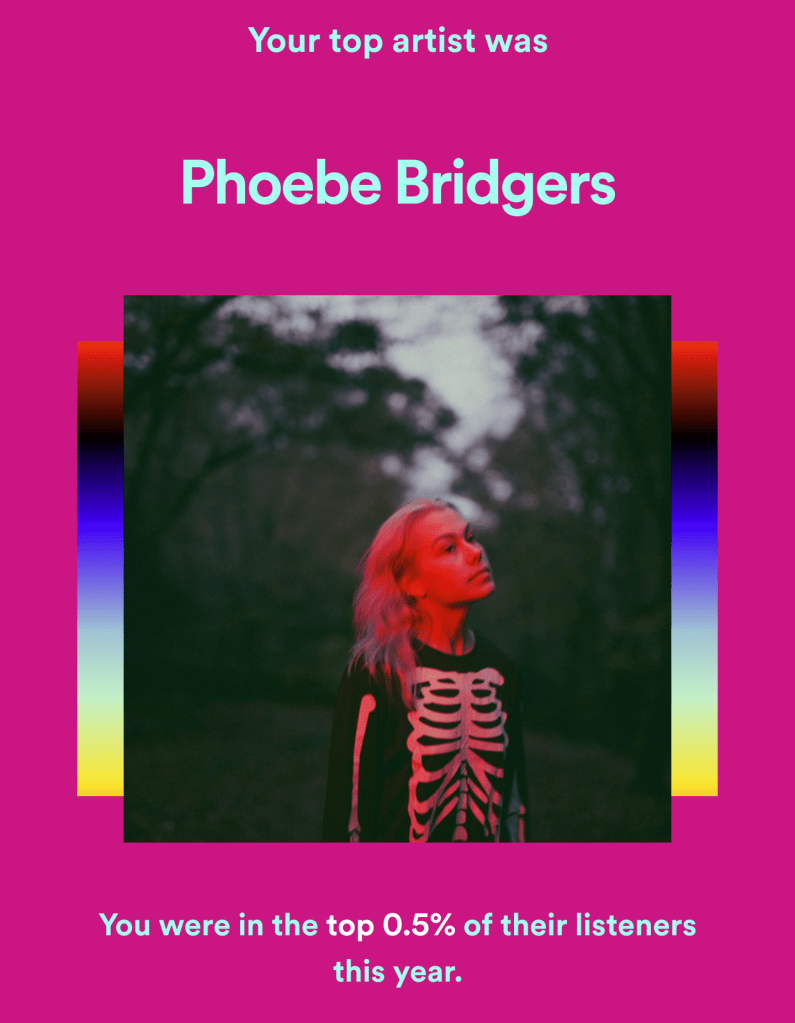
    This was my top song of 2020. Spotify did not hold back this year. This is the song you listened to most, Spotify told me, and you listened to it a stupid amount of times in a very small window, and that window was the weeks you were the saddest out of this entire forsaken year, and all your sadness was self-inflicted, you should have known better, but congrats, you’ve listened to 2,043 minutes of Phoebe Bridgers this year, which lands you in the top .5% of listeners! (Fun fact: 2,043 minutes is 34 hours of music and what’s hilarious and sad is that all of those 34 hours come from listening to the same 9 songs. I can’t even name all the tracks from Punisher. . .) Anyway, this song has no chorus and just tells a story, which is one of my favorite song formats. I can understand why people are underwhelmed with this song and think it’s overhyped, but if you’re the right type of person going through the wrong type of thing, it’ll grip your bones and shake them in just the right way.

    Somebody That I Used to Know, Gotye feat. Kimbra
    Everyone listened to this song on repeat. Be honest. It’s great. It made it to mainstream radio, but it was indie enough—what instrument is even playing in the beginning?—to still be interesting after 50 listens. It’s such a lowkey rage song, and I love it.

    Vindicated, Dashboard Confessional
    Knowing a handful of Dashboard Confessional songs by heart is probably the most millenial thing about me. I used to have Dashboard lyrics in my AIM bio back in middle school, which dates me in so many ways. Back then, I found their lyrics enthralling, although now I feel like they are too vague and Rupi Kaur-like (sorry). But seriously, trace the moment, fall forever, is a lyric that sounds cool but is not as insightful as 7th grade me thought it was. I spent a gross amount of time looking at song lyrics this summer, and let me tell you, Dashboard has nothing on Andrew Bird or Fiona Apple. But that’s a post for another time. . .

    (. . .maybe. If you think I am committing to anything or making any future plans at this point, you are insane.)

  • Would someone who is NOT the main character sit alone and pensively watch the sunset over the vast and open canyon? I thought not.

    “Main character energy” is a phrase that’s cropped up online recently. Wow, look at her! She has main character energy, someone will write. She is the fully realized protagonist at this point, another will chime in. It’s generally commented on videos where the person is especially enigmatic. Their energy radiates. You can’t stop watching them. Part of you wants to be them.

    We are all our own main characters, even if it sometimes feels like we lack agency. This is something we inherently know. We say things like “the rest is still unwritten” (thank you, Natasha Bedingfield) or “we’ll see what the next chapter holds,” using colloquial phrases that imply our life is a narrative constantly being created.

    We survive by telling ourselves stories, both big and small. This year, I’ve been more interested in the small narratives that define our lives.

    In a TikTok video I watched the other month, this woman talks about how she grew up as a theater kid and was never a sports person. As an adult, she impulse bought a soccer ball, started kicking it around, and realized she really enjoyed it. I feel like I’ve gone through my whole life telling stories about myself, she says into the camera. They’re stories I’ve been telling myself for so long, I forgot they were just stories. . . . What if you’re wrong about yourself?

    I took Physics 2 in college and I still remember that first day of class. Engineering majors took calc-based physics, while pre-med students took algebra-based. I had taken zero math courses in college, and the only other science class I’d taken was astronomy, which was less math-focused and more conceptual. I’d tested out of Physics 1, which was cool but really just meant that I hadn’t touched the hard sciences since high school. I was nervous and underprepared. That first day, I walked into the lecture hall full of pre-med majors, noticed my friend in one of the middle rows, and took a seat next to him. He looked at me quizzically and then smiled. What are you doing here? he asked. It was a valid question. I was an English person. The narrative that I was bad at math and a humanities person, not a science one, was one I told myself and other people too. Why on earth was I there?

    What if you’re wrong about yourself?

    The narrative that I’m not a science person is still one I’m working against. I don’t have the academic background in it, but I like it; it’s interesting and there are several subjects that I am fairly well-versed in. I’m an English person masquerading as a science person, I’ve said when people have expressed surprise at my life trajectory and my recent work in outdoor education. Quite honestly, it’s a stupid thing to say. Why can’t you be both? Why isn’t it more normal to be interested in a vast array of subjects, to a be a multitude of people all at once (shoutout to everyone who gets the Whitman reference)?

    If I ever need a smart, nonfiction book, I am going to ask you, my coworker told me the other day after seeing the past three books I’ve read during my breaks. That comment caught me off guard. A nonfiction person. A science person. These have not previously been in the narrative I tell about myself.

    What if you’re wrong about yourself?

    On a larger scale, I’ve also been questioning the cultural narratives we tell ourselves. The biggest lie I’ve uncovered this year in my own life is the myth of stability, which is funny because if you’d asked me what I wanted back in February, I would’ve said exactly that. But COVID changed a lot, and my own belief in stability and certainty is one of them. I feel like my ideas of what my life should be like and what I want are sometimes less rooted in my own feelings and beliefs and more in those of the people and world around me. Thirty is an inherently meaningless number, yet I struggle to liberate myself from the idea that there are certain benchmarks I should have hit by that age.

    What if you’re wrong about yourself?

    The artist Ryan Stadler has this cool art series about banned books where he takes the entire text and alphabetizes it. It’s the same book, the same words, but much of the meaning is lost despite every component still being present. What is perhaps most fascinating about his portrayal is not what is absent, but what remains. You can still tell whom the main characters are by how many times their names are present. You know there was love and heartbreak and that Alaska meant a lot to someone for some reason. The original context is gone, but you create your own. You find meaning in the ordered randomness. In Alaska For Looking, an interpretation of the novel Looking for Alaska, Stadler shares his favorite line in his new alphabetized version: sob sobbing sobbing sobbing sobbing sobbing sobbing sober sober sober sobriety, which says a lot without really saying anything at all.

    That’s how I feel about my own life right now. I am the main character, but I can’t make sense of the story. Everything is alphabetized and I know all the plot elements are there, I know good things will happen, but I can’t make figure out what those things will be or what they will look like. There are some days where I feel like I am decidedly in the wrong novel, and others when I feel confident about my direction and the choices I have made. I envy the people who can map their lives so linearly, who know who’ll they’ll be a year from now and what they’ll want (*cough*Clare*cough*).

    But it also excites me that I don’t know, that I am susceptible to change. My life is richer because of its flexibility, because of my ability to be fluid and to change my mind. Sometimes it is hard to see that as a gift. Sometimes it is hard to view my life without superimposing traditional narratives over it.

    What if you’re wrong about yourself?

    The thing about main character energy is that it isn’t always captivating. People use the phrase to describe the moment when they’re driving into the sunset and Lord Huron is blasting through the speakers and they just broke up with their girlfriend, and wow, look at how free they are, look at how the land welcomes them with open arms, look at all that wonder that lays ahead. And that’s the scene in the book, in the movie, that you remember. That’s what sticks. But what you fail to recognize are the quiet lines, the moments that exist between scenes, the mere second of darkness that exists on the screen before a new colorful image takes its place. You read the line, and autumn bled into winter, a desiccated shell of the vibrant summer months in a second. You, the reader, move on. But the main character doesn’t. They have to live those months, those moments that are not glamorous, the scenes that the movie and the book only lightly touch. They have to live it all.

    (Side note: Would love to link to the TikTok video mentioned above, but figuring out how to link to TikTok via WordPress is above my paygrade. Sorry.)